AEO Playbook for CMOs: From Crawler Access to Citation Measurement
A step-by-step AEO playbook for CMOs: fix crawler access, answer fit and trust, then gate a six-month engagement at day 30, 60 and 90 with pass/fail tests.
Request a quote and our experts will contact you within 24 hours with tailored solutions and pricing.
AEO Playbook for CMOs: From Crawler Access to Citation Measurement
An AEO (answer engine optimization) playbook is a sequenced plan that fixes crawler access, answer fit and source trust, in that order, and ties each fix to a 90-day stage-gate a CEO can approve or cancel. Organic pipeline is shrinking because the click is disappearing: links inside an AI summary were clicked in only 1% of visits (Pew Research Center, 2025). Publishing more posts fixes none of the three failure points. This AEO playbook is built for a CMO asked to fund $9,000 to $36,000 over six months before the first signal. For tool choices, see AI search visibility tools to evaluate.
By Ishan Manchanda, co-founder of GrowthSpree, a B2B SaaS marketing consultancy that has managed $60M+ in ad spend across 300+ B2B SaaS companies. Disclosure: GrowthSpree and its managed AEO service, Salient, are affiliated with the publisher of this article.
Key Takeaways
An AEO playbook works through three failure points in order, access, answer fit, then trust, because a page that AI crawlers cannot fetch cannot be cited however well it answers or how trusted its source is.
Crawler access must be audited bot by bot, because 48.9% of sites that block GPTBot still allow OAI-SearchBot (AI Crawler Check, 2026).
Three stage-gates (Day 30, Day 60, Day 90) let a CMO stop spending when leading indicators miss, before the full six-month commitment is paid.
A six-month AEO engagement at $1,500 to $6,000 a month costs $9,000 to $36,000, which is 0.4 to 1.6 break-even deals at $30,000 ACV and 75% margin (AeoGeo's illustrative model).
What is an AEO playbook, and how is it different from an SEO plan?
An AEO playbook is a staged operating plan for getting a company named in AI-generated answers. It differs from an SEO plan in what it measures: citations and recommendations instead of rankings. Google users clicked a traditional result link in 8% of visits with an AI summary, against 15% of visits without one (Pew Research Center, 2025).
Glass maze seen from above with one lit path ending at a single glowing answer card
The same Pew analysis found that "For searches that resulted in an AI-generated summary, users very rarely clicked on the sources cited." (Pew Research Center, 2025) The click is no longer the outcome, so the lead metric has to change.
Citation frequency is the number of runs, out of N repeated runs of a fixed prompt set, in which an assistant names or links the company. It replaces rank as the headline number. Crawlability, content quality and authority overlap with SEO. Almost everything else differs:
Dimension
SEO plan
AEO playbook
Lead metric
Rankings and organic sessions
Citation frequency (cited in x of N runs)
Unit of work
Keyword-targeted page
Page that answers one buyer question in extractable form
Access
Indexing and sitemaps
Per-bot policy for search and training crawlers
Trust
Backlinks
Third-party corroboration of the company's claims
Review rhythm
Monthly rank report
Day 30, 60 and 90 gates
What are the step-by-step stages of an AEO playbook built for CMOs?
An AEO playbook for CMOs has three steps, run in order: Step 1 fixes crawler access, Step 2 fixes answer fit, Step 3 builds trust, checked at Day 30, Day 60 and Day 90 gates. The Failure-Point Test is the diagnostic behind them: can the machine read the page, does it answer the exact question, is the source trusted.
Three interlocking rings in navy and blue representing access, answer fit and trust
The Failure-Point Test is a three-part diagnostic of whether the machine can read a page, whether it answers the exact question, and whether the source is trusted. A page needs all three at once, so a blocked page cannot be cited however good it is. Each failure point needs a test, a first action, a named owner and evidence of the fix:
Failure point
Test
First action
Owner
Evidence of fix
Access
Per-bot check of robots.txt, CDN/WAF rules and rendering
Write a per-bot policy by path
Engineering with SEO
Server-log hits from allowed bots
Answer fit
Run a fixed prompt set of long buyer questions
Rewrite pages to answer one question each
Content and product marketing
Citation frequency vs baseline
Trust
Check which third-party sources the assistants cite
Earn corroboration for core claims
Marketing and PR
Citations naming the company with correct facts
Step 1: fix crawler access
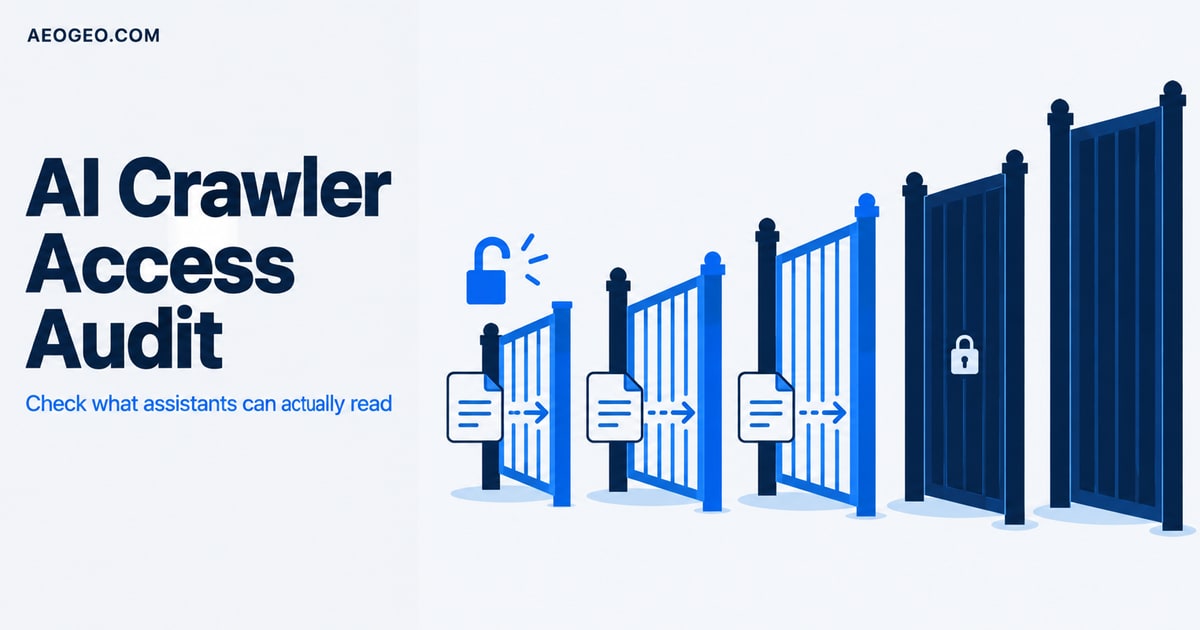
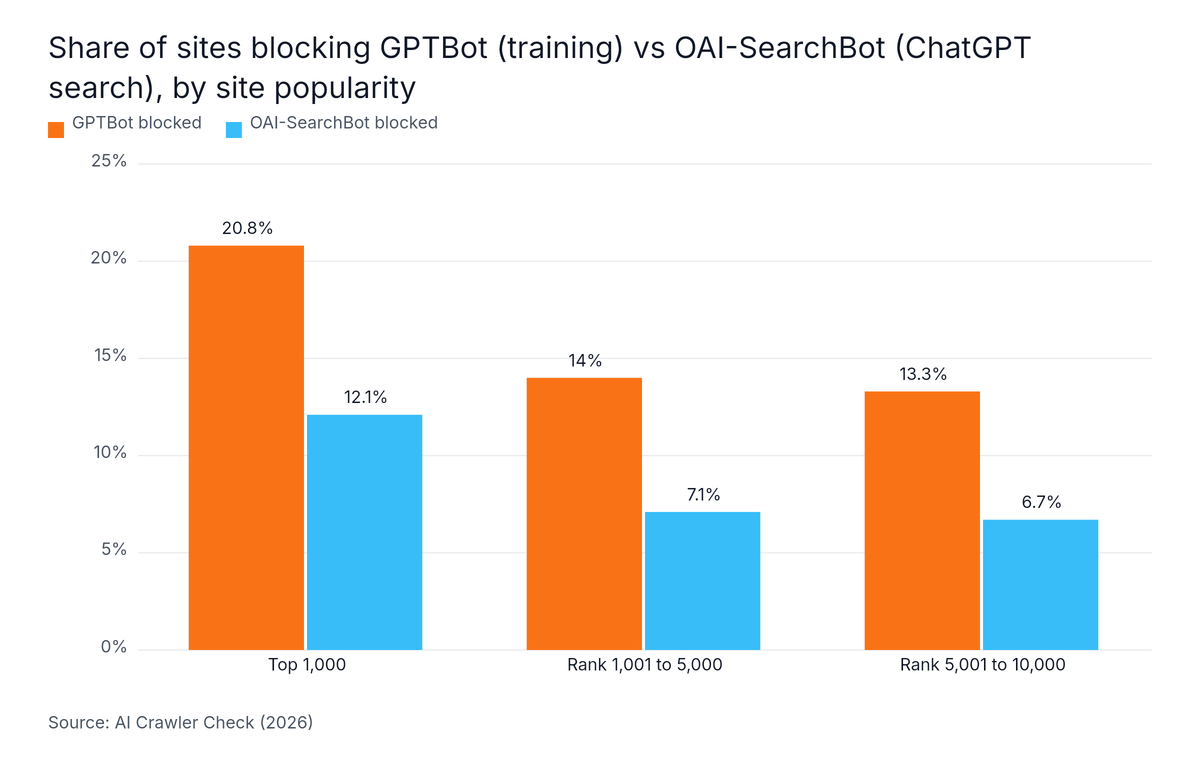
Per-bot policy is a written rule, by path, for each AI crawler stating whether it is allowed, blocked or rate-limited. Marketing, infrastructure, front end and product each control a layer, so nobody sees the whole picture. A blanket rule is usually wrong. AI Crawler Check parsed 4,962 robots.txt files from the top 10,000 sites in 2026: 14.3% block GPTBot site-wide, and 7.4% block OAI-SearchBot, the crawler behind ChatGPT search (AI Crawler Check, 2026).
Blocking training and allowing search is often deliberate: 347 of 710 GPTBot blockers (48.9%) still allow OAI-SearchBot (AI Crawler Check, 2026). A separate check of 945 well-known sites found 9.4% block OAI-SearchBot, 16.9% block GPTBot and 25.9% block at least one AI crawler (Kavel, 2026). A secondary vendor report says Anthropic now runs Claude-SearchBot separately from ClaudeBot (Technology Checker, 2026); confirm that in Anthropic's own documentation.
Run this pre-signature access audit:
List every AI crawler by purpose: training, search and user-triggered.
Read robots.txt, then the CDN/WAF bot rules, then check whether key pages render without JavaScript.
Set a per-bot policy by path and name one owner.
Turn on server-log capture so allowed bots can be seen arriving.
In the AI Crawler Check dataset, block rates fall with site popularity rank: 20.8% for the top 1,000 sites, 14% for ranks 1,001 to 5,000 and 13.3% for ranks 5,001 to 10,000 (AI Crawler Check, 2026).
Step 2: fix answer fit
Answer fit is whether a page answers one exact question in a form a machine can lift. Build the prompt set from long, conversational buyer questions, because they trigger AI summaries far more often: 8% of one- or two-word searches versus 53% of searches with 10 or more words (Pew Research Center, 2025).
To build the prompt set, take real buyer questions from call recordings, sales emails and the "how did you hear about us" field. Keep each as a full sentence. Then give each question its own page section with a direct answer first. For example, the question "What should a B2B marketing team check before signing a six-month AEO contract?" becomes a heading followed by a short answer: a B2B marketing team should check whether AI crawlers can fetch its key pages, whether those pages answer buyer questions directly, and whether third parties corroborate its claims. Evidence, tables and links sit below that paragraph.
Step 3: build trust
Trust is where buying your way in fails. Paid and advertorial content makes up only 0.3% of AI citations, and about 99% of cited links come from non-paid sources (Muck Rack, 2026). The source mix also moves: "Journalism's share of AI citations fell from 27% to 22%, the biggest significant shift across four editions of the study" (Muck Rack, 2026).
Turn that into four actions:
List the third-party sources the assistants cite for each prompt in the fixed set.
Check that each source states the company's facts correctly: what it does, who it serves and its price band.
Earn or correct coverage on the sources that recur, starting with the core claims.
Re-baseline each quarter, because the source mix is shifting.
How should a CMO set 90-day stage-gates for an AEO engagement?
A stage-gate is a dated checkpoint with pass or fail criteria that must be met before the next payment is released. An AEO engagement needs three: Day 30 for access and baseline, Day 60 for shipped answer-fit pages, and Day 90 for the first measured movement in citation frequency, with pipeline judged at Day 180.
Three small archways of rising height with lit indicators on a pale surface
Gate
Deadline
Pass criterion
Evidence a CEO can see
1. Access and baseline
Day 30
Per-bot policy live; baseline citation frequency recorded on a fixed prompt set
Policy document, log report, baseline range
2. Answer fit shipped
Day 60
Agreed pages published, server-rendered, answering named buyer questions
Page list mapped to prompt set
3. First movement
Day 90
Citation frequency above baseline range on the same prompt set and same N
Month-over-month range, GA4 AI channel group, self-reported attribution
A kill criterion is a pre-agreed result that, if missed at a gate, ends the engagement. Write it into the contract before signing.
Measure small traffic honestly
AI traffic is small, so gates cannot rest on clicks. Conductor's 2026 benchmarks put AI referral traffic at 1.08% of total website traffic across 10 industries, with IT highest at 2.8% (Conductor, 2026). In Conductor's words, "AI referral traffic currently represents just over 1% of total web visits and is growing by roughly 1% each month, on average." (Conductor, 2026) The sample is enterprise-heavy, so treat it as an upper-leaning benchmark.
ChatGPT accounts for 87.4% of AI referral traffic in that dataset, a point-in-time number, so start the prompt set there (Conductor, 2026). Fix the prompt set and the number of runs N before the baseline. AI answers are non-deterministic: as an illustration, a page cited in 14 of 50 runs can look uncited in one check. Report ranges, not points, and add AI-referred sessions and self-reported attribution.
How much should a CMO budget for a six-month AEO engagement?
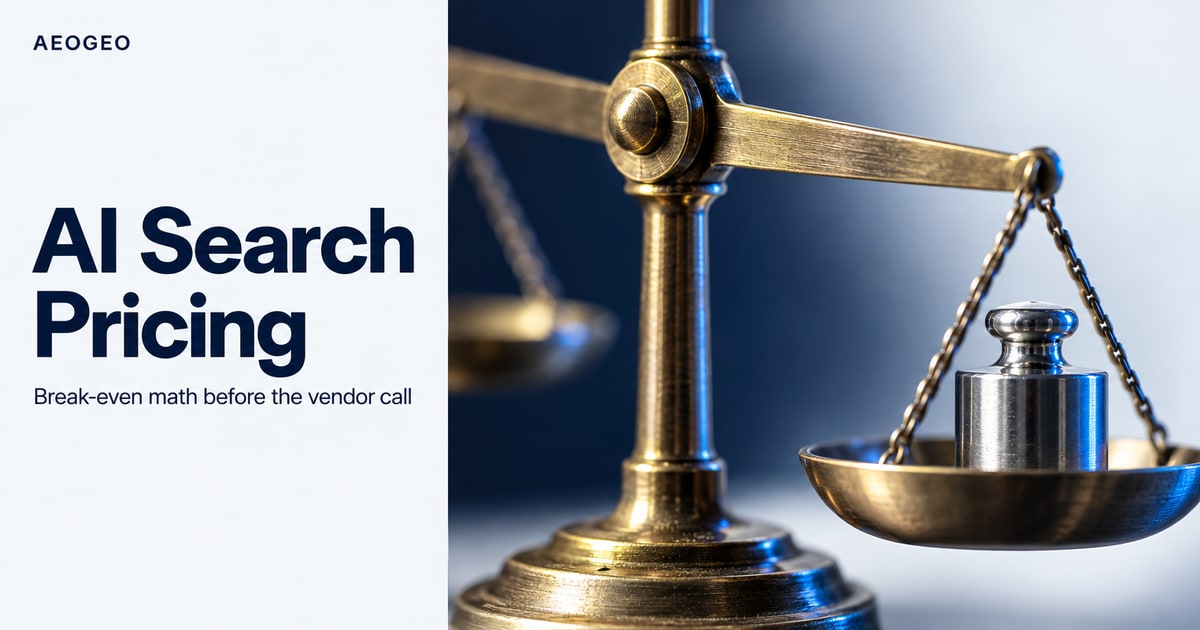
AeoGeo's illustrative commitment model puts a six-month AEO engagement at $9,000 at $1,500 a month, $18,000 at $3,000 and $36,000 at $6,000 (AeoGeo's own estimate, not a quote). Cash out before the Day 90 gate is $4,500 to $18,000. Break-even deals equal spend divided by (ACV x gross margin): 0.4 to 1.6 deals at $30,000 ACV and 75% margin.
Brass balance scale with a coin stack on one side and a single key on the other
Break-even deals is the number of new customers needed to repay the spend at a given contract value and margin. The table applies it at 75% gross margin:
Monthly spend
Six-month total
Cash out by Day 90
Break-even deals at $30,000 ACV
Break-even deals at $100,000 ACV
$1,500
$9,000
$4,500
0.4
0.12
$3,000
$18,000
$9,000
0.8
0.24
$6,000
$36,000
$18,000
1.6
0.48
These are illustrative figures, not financial advice and not a forecast of results.
What the CEO ask is up against
Budgets are flat. Gartner's 2026 CMO Spend Survey found CMOs allocating 15.3% of budgets to AI while only 30% report mature readiness to scale, and 56% say they lack budget for their strategy (Gartner, 2026). A request framed as reallocation with gates is easier to approve than new money.
Reallocation has a source, though not an independent one. GrowthSpree's own paid-media audits (company-reported, audit date not published, affiliated with the publisher) found 34.0% of Google Ads spend wasted across 104 accounts and $78.0M audited, and 32% of LinkedIn Ads spend wasted across 56 accounts and $9.4M. Treat those as indicative, not as a benchmark.
Our data: Salient by GrowthSpree, GrowthSpree's managed AEO service launched in September 2026, reports 48,800 citations, $165,000+ pipeline and $70,000 media-equivalent across clients (Salient pitch deck, 2026). These are company-reported results with the affiliation disclosed, not independent research.
What should an AEO vendor deliver in month 1 before we keep paying?
An AEO vendor's month-1 deliverables should be a written access audit with a per-bot policy, a baseline citation-frequency range on a fixed prompt set, a named internal owner, and a 90-day exit clause with a kill criterion. A vendor that cannot show these within 30 days has not earned the next payment.
Test the access audit first. Ask the vendor to name every bot it checked and to separate training bots (GPTBot, ClaudeBot, Google-Extended) from search bots (OAI-SearchBot, PerplexityBot). A vendor that reports only "AI crawlers: allowed" has not done the bot-by-bot work.
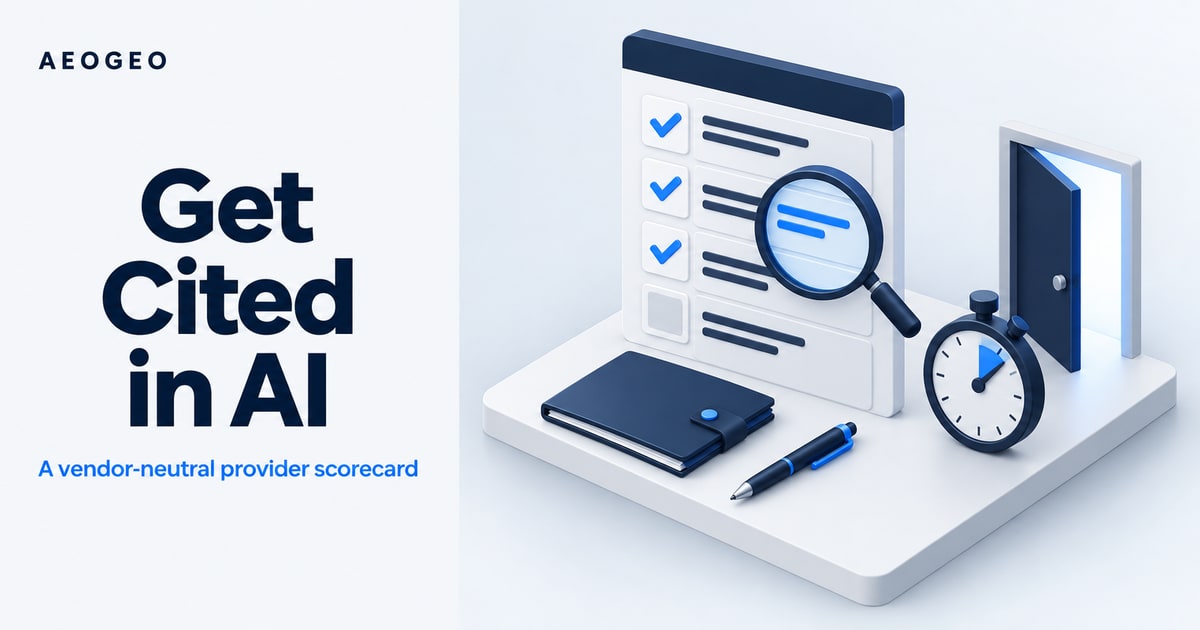
Use this checklist at the Day 30 gate:
A written access audit and per-bot policy.
A baseline citation-frequency range on a fixed prompt set, with N stated.
A named internal owner and a RACI across content, product, engineering and RevOps.
A 90-day exit clause and a kill criterion.
Written confirmation that the company owns the data and the prompt set.
Who is this AEO playbook not for?
An AEO playbook is not for companies with very small or gated websites, buyers who do not research online, or teams that need guaranteed results. AI referral traffic is just over 1% of total web visits (Conductor, 2026), so the business case cannot rest on clicks, and no vendor can honestly promise citations or revenue.
A closed padlock beside an open miniature door on a plain grey background
Thin or gated sites: with very few indexable pages, or content behind logins, fix the site first.
Teams wanting a ranking number: the playbook reports citation frequency ranges, not positions.
Buyers who may not use AI: run a 30-day test of call recordings, self-reported attribution and win/loss notes before funding anything.
Small teams: a minimum program can cost hours, not a retainer: fix crawler access, add "AI assistant" to the lead form, and publish ten answer pages.
Results claims: the break-even figures are illustrative, and the Salient results are company-reported.
Frequently Asked Questions
If we block GPTBot, will ChatGPT stop citing us?
Blocking GPTBot alone does not necessarily remove a site from ChatGPT search, because OAI-SearchBot is the separate crawler behind ChatGPT search. AI Crawler Check found in 2026 that 347 of 710 sites blocking GPTBot (48.9%) still allow OAI-SearchBot. Audit each bot separately rather than applying one allow or block rule.
How do I check whether our site is accidentally blocking OAI-SearchBot or Claude-SearchBot?
To check whether a site blocks OAI-SearchBot or Claude-SearchBot, read robots.txt for rules naming each bot, then review CDN and WAF bot settings, then confirm in server logs that each bot actually arrives. A CDN rule can override an allowing robots.txt. A secondary vendor report from 2026 describes Claude-SearchBot as separate from ClaudeBot, so confirm in Anthropic's documentation.
How long does it take to see the first measurable AEO result?
The first measurable AEO result should be testable at Day 90, when the stage-gate compares citation frequency against a baseline taken in the first 30 days. Practitioner reports quote 90 to 180 days to results, which is anecdotal. Pipeline impact belongs at a later Day 180 gate, because leading indicators move before revenue does.
How much traffic do AI platforms actually send to websites?
AI platforms send a small share of traffic: Conductor's 2026 benchmarks report puts AI referral traffic at 1.08% of total website traffic across 10 industries, with IT highest at 2.8%. That sample is enterprise-heavy and may skew higher than broad-web samples, so the business case should rest on citation presence and lead quality, not clicks.
How many times should I run a prompt before trusting a citation-share number?
No verified standard number of runs exists for citation-share measurement, so fix N before the baseline and never change it mid-engagement. AI answers are non-deterministic, so as an illustration a page cited in 14 of 50 runs can look uncited in one check. Report citation frequency as a range across the same prompt set each month.
Conclusion
A defensible AEO recommendation to the CEO rests on sequence, not volume. Fix access first, then answer fit, then trust, and release money only as each gate passes.
Audit crawler access bot by bot before signing anything.
Fix the prompt set and the number of runs N before the baseline.
Hold three gates: Day 30, Day 60 and Day 90, with a written kill criterion.
Size the spend as break-even deals: 0.4 to 1.6 at $30,000 ACV and 75% margin.
Expect small referral traffic and judge on citation frequency and lead quality.
Take these gates into the vendor conversation, and get the weekly brief on AI search platform and crawler changes that should trigger a re-baseline.
Written by
Ishan Manchanda
Ishan Manchanda is co-founder of GrowthSpree, a B2B SaaS marketing consultancy founded in 2017 that has managed $60M+ in ad spend across 300+ B2B SaaS companies. He focuses on demand generation, go-to-market strategy and pipeline growth, and has been featured in Silicon Valley Times, SaaS Mag and the Unbounce podcast.
 Ishan ManchandaNov 6, 2026