Blog
AI Crawler Access Audit: How to Check Whether AI Assistants Can Read Your Site
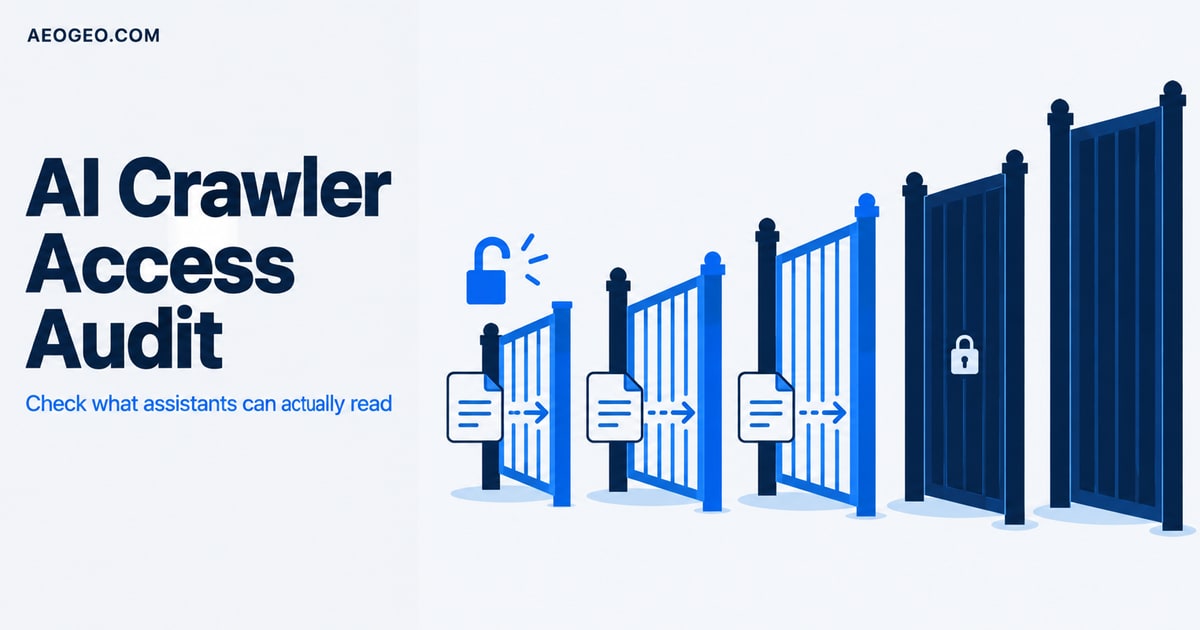
Run an AI crawler access audit in five layers: robots.txt, CDN/WAF rules, rate limits, origin and rendering. Includes a per-bot policy table and owner model.
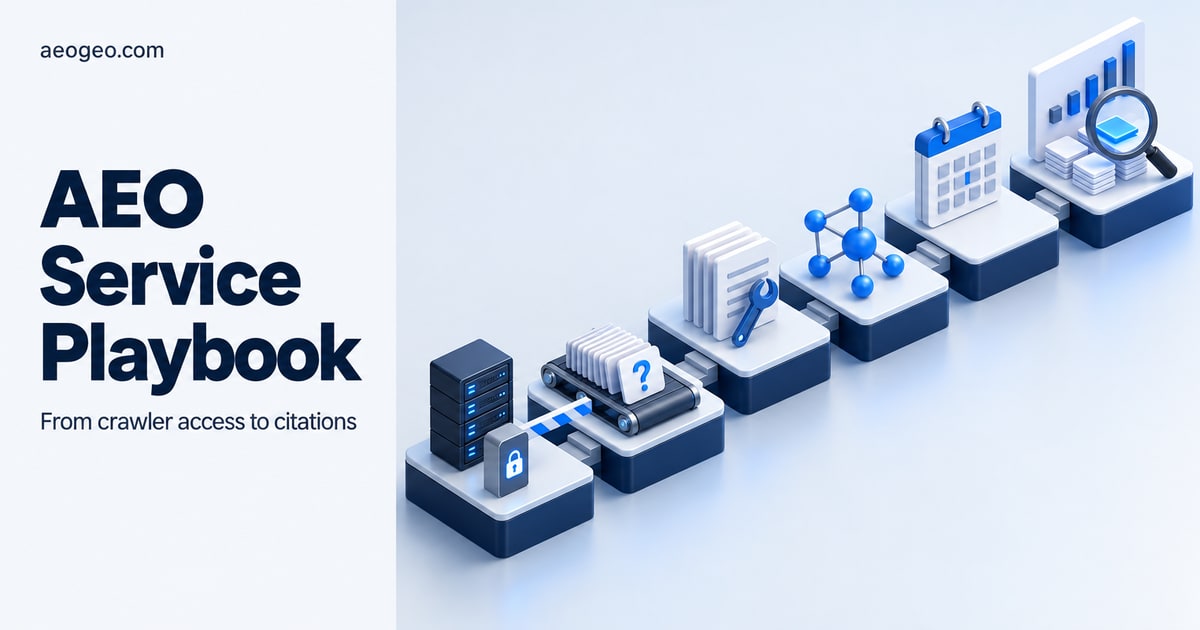
What an AEO service playbook covers: access and crawler policy, baseline prompt sets, technical fixes, citation measurement, cadence and cost, stage by stage.
 Ishan ManchandaNov 10, 2026
Run an AI crawler access audit in five layers: robots.txt, CDN/WAF rules, rate limits, origin and rendering. Includes a per-bot policy table and owner model.
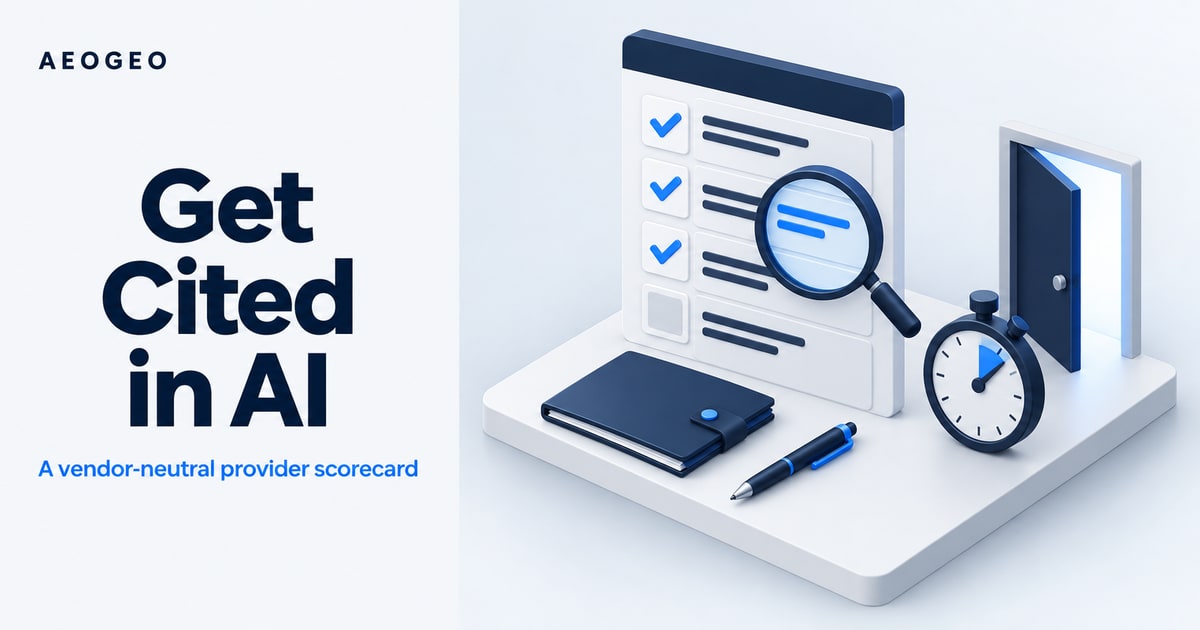
A vendor-neutral scorecard for choosing who can help you get cited in AI answers: metrics, attribution, kill criteria, contract terms and break-even math.
AI search visibility platforms cost $99 to $20,000 a month. See dated price bands by source and the break-even math: 0.4 to 1.6 deals at $30K ACV.
Request a quote and our experts will contact you within 24 hours with tailored solutions and pricing.
Last updated: Nov 10, 2026
By Ishan Manchanda, co-founder of GrowthSpree, a B2B SaaS marketing consultancy founded in 2017 that has managed $60M+ in ad spend across 300+ B2B SaaS companies. Published October 28, 2026. Disclosure: aeogeo.com is a GrowthSpree property.
An answer engine optimization (AEO) service playbook is the documented sequence an agency follows to make a client's site readable, citable and measurable in AI answers, from access and permissions through to citation reporting. Most CMOs who ask what's the AEO service playbook for agencies get a dashboard demo instead of a sequence. That makes scope, cost and progress hard to judge. This guide lays out the six stages in order, who owns each one, what the evidence says, and where the method has real limits. It also shows how to audit an agency at each stage, whether you are choosing one with a structured agency comparison or reviewing one you already pay.
Key Takeaways
- An AEO service playbook runs six stages: access, baseline prompt set, technical fixes, content and third-party work, measurement cadence, and reporting.
- Access comes first: a page an AI crawler cannot fetch cannot be cited, and robots.txt can say "allow" while a CDN or WAF still blocks the bot.
- AI answers rarely repeat: SparkToro found fewer than 1 in 100 runs returned the identical brand list, so agencies must report frequency ranges, not single ranks.
- Google's guidance says optimizing for generative AI search is still SEO, so a credible AEO playbook separates Google-specific work from cross-engine work.
- Six months of AEO spend at $1,500 to $6,000 a month is $9,000 to $36,000, so each stage needs a 90-day checkpoint and a kill criterion.
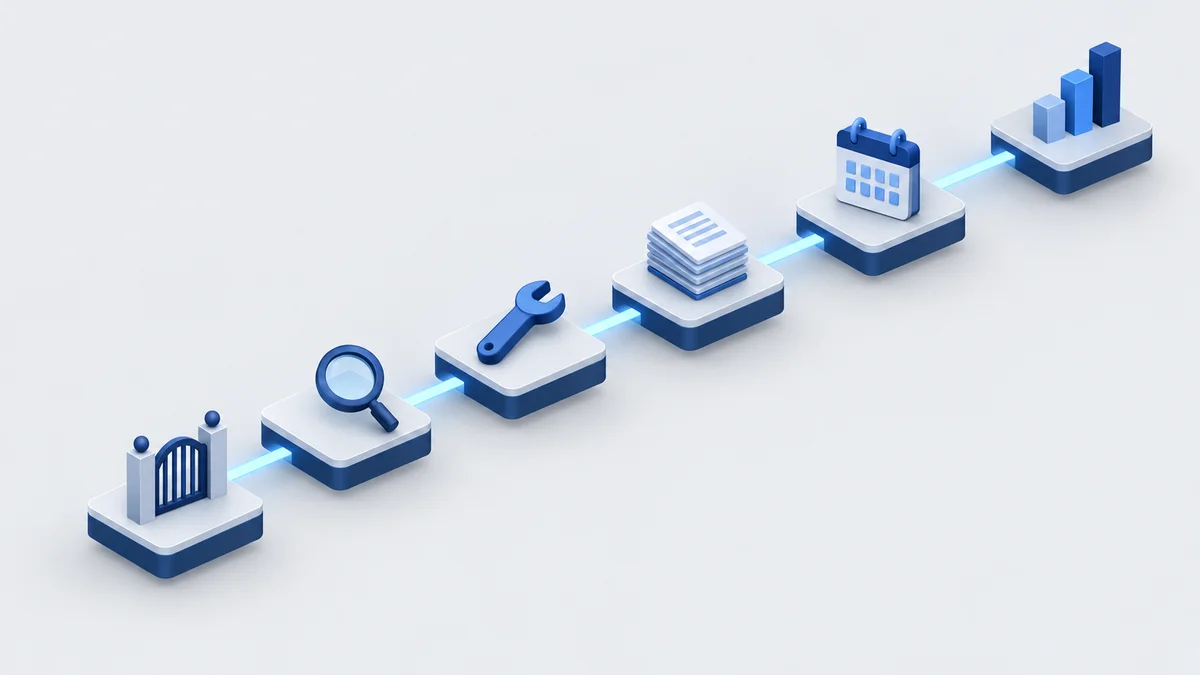
An AEO service playbook for agencies is a written, staged procedure covering six jobs in order: access and permissions, a baseline prompt set, technical fixes, content and third-party work, a measurement cadence, and client reporting. It matters because 78% of practitioners surveyed said their current approach to measuring LLM visibility is inaccurate (G2 Learning Hub, 2026), so an auditable sequence beats a dashboard.
AEO is the practice of making a brand's pages the ones AI assistants and AI search features retrieve and cite when buyers ask questions. GEO (generative engine optimization) is a near-synonym that emphasizes generative answers. Both overlap heavily with SEO. A citation is a named or linked reference to a brand's page or domain inside an AI answer, and it is the unit an AEO playbook ultimately counts.
The table summarizes what each stage delivers and how a client can verify it was done.
| Stage | What the agency does | Typical owner on the client side | Proof it was done |
|---|---|---|---|
| 1. Access and permissions | Inventories robots.txt, CDN/WAF rules, rendering and logins; sets per-bot policy | Engineering and SEO | Signed access spec and log sample |
| 2. Baseline prompt set | Fixes a list of buyer questions and runs them repeatedly | Marketing and RevOps | Baseline frequency ranges by engine |
| 3. Technical fixes | Resolves rendering, blocked paths and parsing problems | Engineering | Before and after fetch results |
| 4. Content and third-party work | Rewrites pages to answer exact questions; builds corroboration | Content and product marketing | Pages changed, sources earned |
| 5. Measurement cadence | Weekly spot checks, monthly report, quarterly reset | Marketing and RevOps | Calendar and report archive |
| 6. Reporting | Reports citation ranges, AI-referred sessions, pipeline | CMO and finance | Report tied to CRM stages |
Most pages that cover agency AEO work describe one or two of these stages, so a client rarely sees the whole sequence in one place.
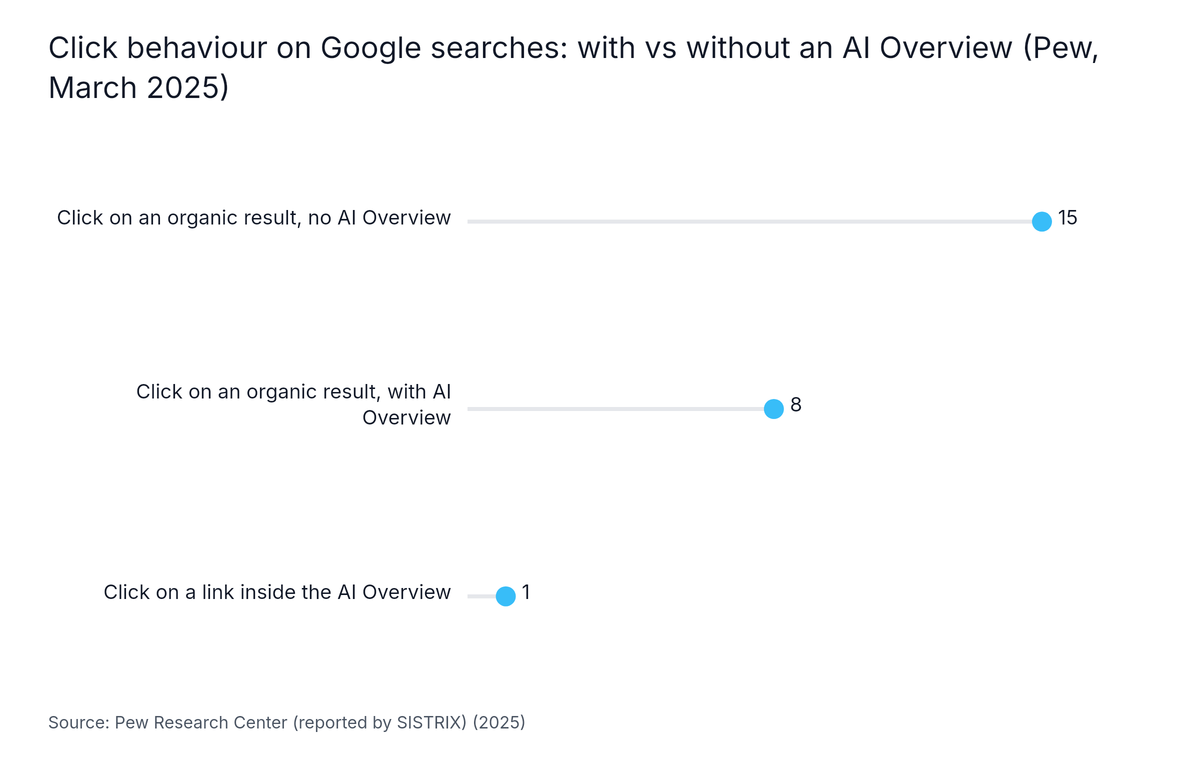
An AEO playbook matters now because AI answers absorb clicks: Pew Research Center found people clicked a traditional result on about 15% of Google searches without an AI Overview and around 8% with one (Pew Research Center, via SISTRIX, 2025). When clicks fall, the goal shifts from rankings to citations, and agencies need a method for earning and counting them.
The Pew panel covered nearly 70,000 Google searches from around 900 US users in March 2025. Links inside the AI Overview itself were clicked in only about 1% of cases (Pew Research Center, via SISTRIX, 2025). Being cited therefore does not guarantee being visited. Note that SISTRIX is a secondary report of the Pew study.
Source: Pew Research Center (reported by SISTRIX), 2025
Google disputes the study, calling it "a flawed methodology and skewed queryset that is not representative of Search traffic" (PPC Land, 2025). The direction is supported elsewhere. Ahrefs found the top result's click-through rate was 58% lower for keywords that show an AI Overview, in a December 2025 sample of 300,000 keywords (Ahrefs, via Searchmaxxed, 2026). That too is a secondary report, as Ahrefs' own page was not reviewed.
AI Overview trigger rate is the share of searches that show an AI Overview, and it differs sharply by sector. One analysis attributed to Conductor and reported by geoaura.world found 25.11% of 21.9 million searches triggered one, ranging from 48.75% in Health Care to 4.48% in Real Estate (geoaura.world, reporting Conductor, 2026). That secondary report should be checked against Conductor's own publication before it goes in a board deck. As a sizing guide, a sector near 5% needs a lighter program than one near 50%.
An AEO playbook starts with access and permissions because a page an AI crawler cannot fetch cannot be cited. Stage one inventories four layers: robots.txt, CDN and WAF bot rules, page rendering, and logins or paywalls. It then sets a per-bot policy by path, and requests analytics and Search Console access so a baseline can be measured.
The four layers usually belong to four teams. Robots.txt sits with SEO, bot rules with infrastructure, rendering with front-end engineering, and logins with product. Cloudflare began blocking AI crawlers by default in July 2025, so a site can show "allow" in robots.txt while the CDN still returns a block. Agencies should verify with server logs, checking for 200 responses versus 403 responses, rather than reading robots.txt alone.
Per-bot policy is a rule set that allows or blocks each AI crawler by purpose and by site path, instead of one allow-or-block setting for all bots. GrowthSpree's working policy is to allow search and retrieval bots on public marketing and docs paths, decide training bots separately, and rate-limit and log everything.
| Crawler | Primary purpose | Default stance in a playbook |
|---|---|---|
| OAI-SearchBot | Search and retrieval for ChatGPT | Allow on public paths |
| PerplexityBot | Search and retrieval for Perplexity | Allow on public paths |
| GPTBot | Model training | Decide separately by IP position |
| ClaudeBot | Model training | Decide separately; rate-limit and log |
| Google-Extended | Controls use of content for Google's AI models | Decide separately |
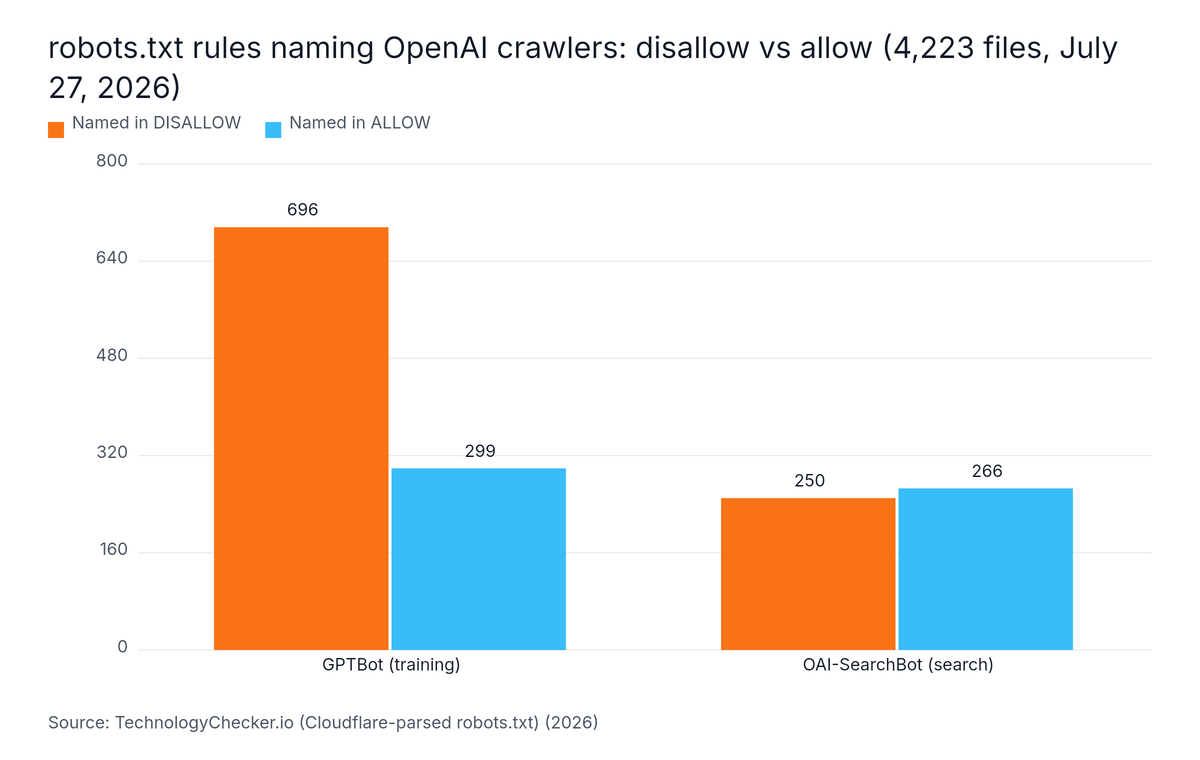
Publishers already split this way. In 4,223 robots.txt files Cloudflare parsed on July 27, 2026, GPTBot was disallowed 2.33 times for every time it was allowed, while OAI-SearchBot's block-to-allow ratio was 0.94 to 1 (TechnologyChecker.io, 2026).
Source: TechnologyChecker.io (Cloudflare-parsed robots.txt), 2026
In TechnologyChecker.io's July 2026 sample of 4,223 robots.txt files, 696 rules named GPTBot and 250 named OAI-SearchBot.
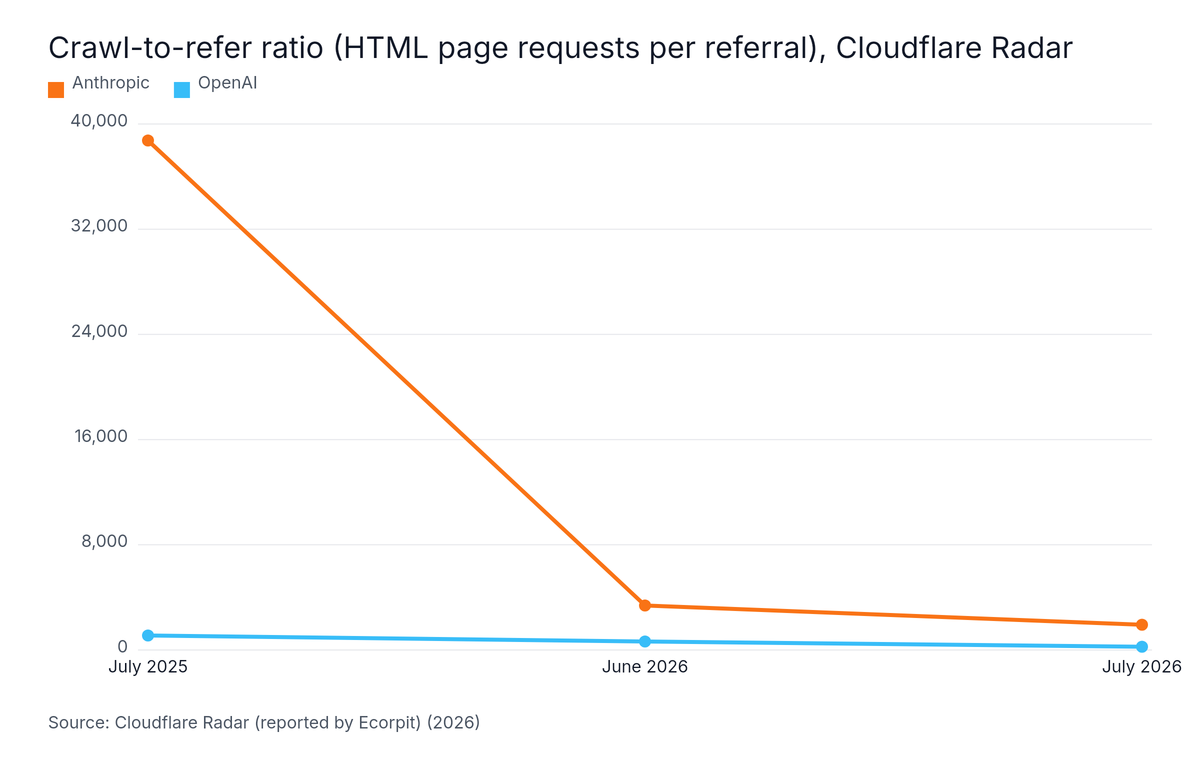
Crawl-to-refer ratio is the number of HTML page requests an AI crawler makes for each referral it sends back. In July 2026 Cloudflare Radar put Anthropic at 1,917:1, OpenAI at 251:1 and Google at 4.7:1 (Cloudflare Radar, via Ecorpit, 2026). Other pages quote different windows, so treat these as directional and always state the window.
Source: Cloudflare Radar (reported by Ecorpit), 2026
Anthropic's ratio was 38,744:1 in July 2025 and 1,917:1 in July 2026, a steep fall in a year. Crawl load is still real. One site reported ClaudeBot at 700,000 hits in a month, enough to trip a bandwidth limit. That is why the stage-one deliverable includes a monthly log report and one named owner.
A baseline prompt set is a fixed list of buyer questions that an agency runs repeatedly across engines and records as a frequency range, such as cited in 14 of 50 runs. Repetition is required because SparkToro found fewer than 1 in 100 runs returned the identical brand list (SparkToro, via rampify.dev, 2026).
Prompt set is the term for that fixed list, and it should map to the buying committee: which questions each persona asks at each buying stage. The baseline then shows whether the client appears when a buyer asks an AI for the best option in its category.
The SparkToro study ran 12 prompts, each 60 to 100 times per platform, across ChatGPT, Claude and Google AI Overviews and AI Mode, for 2,961 runs in total. Fewer than 1 in 1,000 runs returned the same brands in the same order. Rand Fishkin's conclusion was blunt: "AI rank tracking is inherently unreliable" (rampify.dev, citing SparkToro, 2026). The practical consequence is that a page cited in 14 of 50 runs looks "not cited" in a single check.
Frequency range is the share of repeated runs in which a brand is cited, reported as a range such as cited in x of N runs. An agency's baseline should include:
Technical and content work follows the baseline in a fixed order: fix rendering and crawlability, rewrite pages to answer the exact buyer question in an extractable form, then build third-party corroboration. The order matters because much of the work overlaps with SEO, so shared fundamentals come before any engine-specific experiments.
GrowthSpree's Failure-Point Test scores each page on three questions: can the machine read it, does it answer the exact question, and is the source trusted. The first fix is ranked by which test fails first. Publishing more volume addresses none of the three on its own.
Google's documentation frames the skeptic position directly: "Optimizing for generative AI search is optimizing for the search experience, and thus still SEO" (Google, as quoted by seo-kreativ.de, 2026). The same May 2026 guidance lists llms.txt, special markup and chunking as unnecessary for Google Search. A credible playbook therefore labels each task as proven, speculative or engine-specific.
| Task | Google Search | ChatGPT, Perplexity, Claude | Label in the playbook |
|---|---|---|---|
| Server-side rendering of key pages | Needed for reliable reading | Needed; client-rendered pages are not reliably read | Proven |
| Answer-first page rewrites | Standard SEO practice | Core to extraction | Proven |
| llms.txt file | Google says unnecessary | Benefit not established | Speculative, tracked |
| Special schema markup | Google says unnecessary | Benefit not established | Speculative, tracked |
| Third-party corroboration | Authority signal | Frequently cited domains are community and reference sources | Proven direction |
Citations concentrate in a few domains. In a Q1 2026 audit of the top 20 domains ChatGPT cites, wikipedia.org held 13.15% and reddit.com 11.97% (5W Public Relations, 2026). The audit sample size is not visible in the excerpt, and it comes from a PR agency, so treat it as directional.
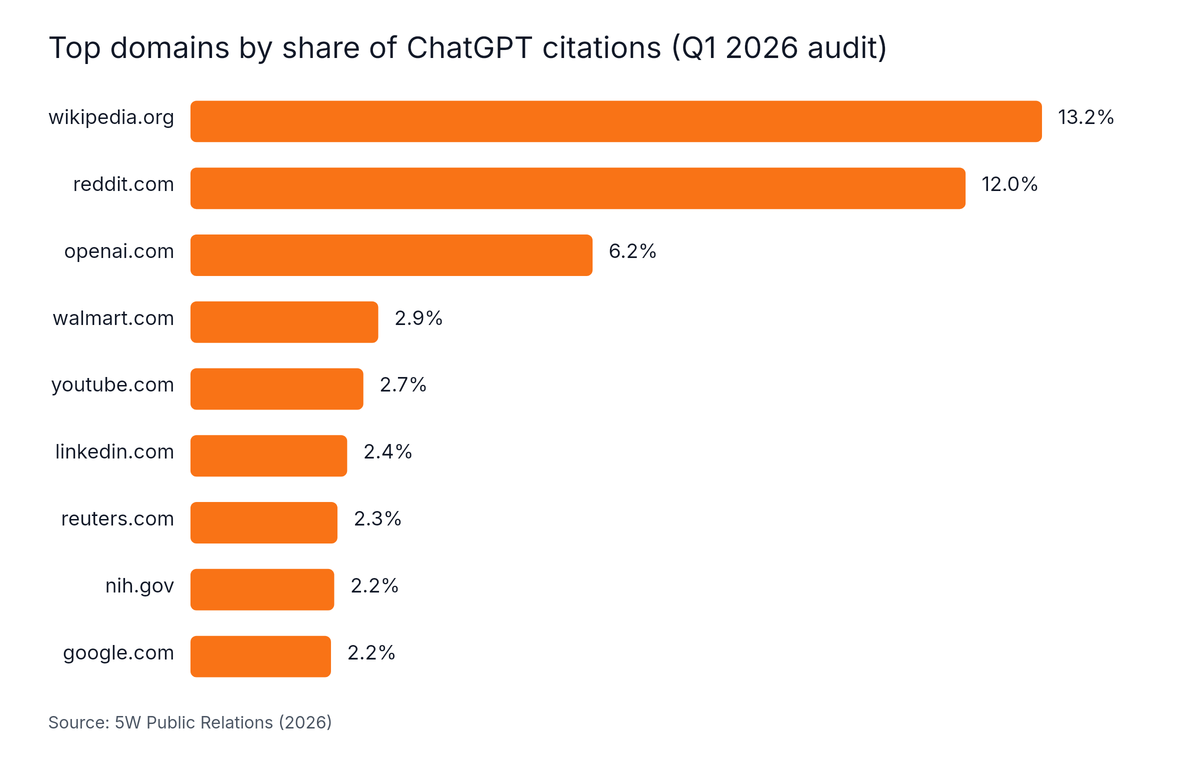
Source: 5W Public Relations, 2026
OpenAI's own domain followed at 6.21% in the same audit (5W Public Relations, 2026). The implication for a playbook is that off-site presence on community and reference sources belongs in the plan, with a rule against inauthentic mentions.
Citation measurement counts how often a client's pages or brand appear in AI answers across a fixed prompt set, reported as a frequency range per engine with competitors alongside. An AEO report should include scope, per-engine ranges, competitors, cited URLs, gaps, changes shipped and AI-referred sessions, because AI referrals were about 1% of traffic across 13,000+ domains (Conductor, BusinessWire, 2025).
The G2 survey of 313 practitioners found 22% are not measuring at all, on top of the 78% who call their approach inaccurate (G2 Learning Hub, 2026). A report that gives one number without a method is part of that problem. Share of answers is the proportion of AI answers on a prompt set that name a given brand, and it should always carry its sample size and run count.
A monthly AEO report that a CFO can read should contain these seven items:
Conductor's 2026 benchmarks, drawn from 3.3 billion sessions, found 87.4% of AI referral traffic came from ChatGPT. Conductor's own summary: "While AI referral traffic remains small in volume, its impact on visibility is outsized" (Conductor, 2026).
Quality may differ from volume. Knotch audience-journey data cited by Conductor indicates that visitors referred directly from LLMs convert at twice the rate and in one-third the sessions of other visitors (Conductor, citing Knotch, 2026), though the sample size is not stated. A report should therefore stack five measures, one per rung of GrowthSpree's Citation-to-Pipeline Ladder: bot access, citation frequency, AI-referred sessions, AI-sourced leads by self-report, and AI-influenced pipeline. For tool selection, see what to evaluate before buying AI visibility tools.
| Cadence | Activity | Output |
|---|---|---|
| Weekly | Spot check of a subset of the prompt set; log review | Short note on blocks, drops or new competitors |
| Monthly | Full prompt-set runs; AI-referred sessions; self-reported attribution | Report with ranges, cited URLs and changes shipped |
| Quarterly | Reset prompt set and priorities; pipeline review | Updated plan and budget decision |
An AEO playbook typically runs about six months, with 90-day leading indicators and 180-day pipeline checks in GrowthSpree's staged-gate pilot template. Salient by GrowthSpree prices its six-month engagement at $999 and $1,500 a month, GrowthSpree retainers start at $3,000, and practitioners quote up to $6,000 (anecdotal), so six months costs $9,000 to $36,000 at $1,500 to $6,000.
Our data: Disclosure: aeogeo.com is a GrowthSpree property. Salient by GrowthSpree, GrowthSpree's managed AEO and GEO service launched in September 2026, reports 48,800 citations, $165,000+ pipeline and $70,000 media-equivalent across clients (Salient pitch deck). These are Salient's reported figures, not independent research.
Break-even deals equal spend divided by (ACV × gross margin). The table is GrowthSpree's illustrative model at a 75% gross margin. The $1,500 row is the top of Salient's listed range, the $3,000 row is where GrowthSpree retainers start, and the $6,000 row is the upper end of anecdotal practitioner quotes on Indie Hackers, which are not verified prices.
| Monthly spend | Six-month cost | Break-even deals at $30,000 ACV | Break-even deals at $100,000 ACV |
|---|---|---|---|
| $1,500 | $9,000 | 0.4 | 0.12 |
| $3,000 | $18,000 | 0.8 | 0.24 |
| $6,000 | $36,000 | 1.6 | 0.48 |
Cash out before the 90-day checkpoint is $4,500 to $18,000 across these tiers. A kill criterion is a pre-agreed result at a fixed date that ends the engagement if it is not met. Write it into the contract with the 90-day indicators.
Payback should be judged on pipeline, not sessions. Pew's finding of about 8% clicks with an AI Overview versus about 15% without (Pew Research Center, via SISTRIX, 2025) shows why a sessions-only case will look weak: the influence happens inside the answer. Practitioner price quotes on forums are anecdotal and mostly vendor-sourced.
Hire an AEO agency when the work needs engineering access, repeated prompt sampling and monthly reporting that the in-house team cannot staff, and ask for the six-stage sequence in writing before signing. Because fewer than 1 in 100 runs returned the identical brand list (SparkToro, via rampify.dev, 2026), the first question is how the agency samples.
Questions to put to any agency, in order:
The choice between funding an in-house AEO team or an agency changes the cost shape but not the need for gates.
An AEO service playbook is not for companies without an active own website, for teams expecting guaranteed citations, or for leaders who need one precise revenue number. The method yields frequency ranges because fewer than 1 in 100 runs returned the identical brand list in SparkToro's January 2026 study (SparkToro, via rampify.dev, 2026), so no single exact figure exists.
Honest limits to state up front:
Small teams can start with hours, not a retainer: fix crawler access, add "AI assistant" to the lead form and publish a handful of answer pages.
An AEO agency's day-to-day work follows the playbook stages: checking crawler access and logs, running a fixed prompt set across engines, shipping technical and content fixes, building third-party corroboration, and reporting citation frequency ranges. Most weeks are spot checks and fixes, while the monthly report and quarterly reset carry the formal measurement.
AEO results are measured by repeating a fixed prompt set many times and reporting how often the brand is cited as a frequency range, such as cited in 14 of 50 runs. SparkToro found fewer than 1 in 100 runs returned the identical brand list (SparkToro, via rampify.dev, 2026), so a single check is noise.
A per-bot policy should allow search and retrieval bots such as OAI-SearchBot on public paths, and treat training bots such as GPTBot as a separate decision. Publishers already split this way: in a July 2026 analysis (TechnologyChecker.io, 2026), GPTBot was disallowed 2.33 times for every time it was allowed, and OAI-SearchBot 0.94 to 1.
Google's May 2026 documentation lists llms.txt, special markup and chunking as unnecessary for Google Search (Google, as quoted by seo-kreativ.de, 2026), saying optimizing for generative AI search is still SEO. Their value on other engines such as ChatGPT or Perplexity is unproven, so an AEO playbook should label them speculative and track results before funding them.
Citation gains from AEO are best judged on a staged timeline: 90-day leading indicators such as crawler access fixed and citation frequency trending, then 180-day pipeline checks. GrowthSpree's staged-gate pilot template uses this structure. Judging earlier on a single prompt check is unreliable because AI answers vary from run to run.
A sound AEO service playbook is a sequence a CMO can audit, not a dashboard. The core takeaways:
The next step is to compare any agency's scope against the six stages, using a shortlist method for B2B SaaS agencies as a scorecard. For weekly platform changes tied to a role and an action, get the weekly Industry Watch brief from aeogeo.com.
Written by
Ishan Manchanda
Ishan Manchanda is co-founder of GrowthSpree, a B2B SaaS marketing consultancy founded in 2017 that has managed $60M+ in ad spend across 300+ B2B SaaS companies. He focuses on demand generation, go-to-market strategy and pipeline growth, and has been featured in Silicon Valley Times, SaaS Mag and the Unbounce podcast.