Blog
In-House AEO Team vs Agency Retainer: How to Decide What to Fund First
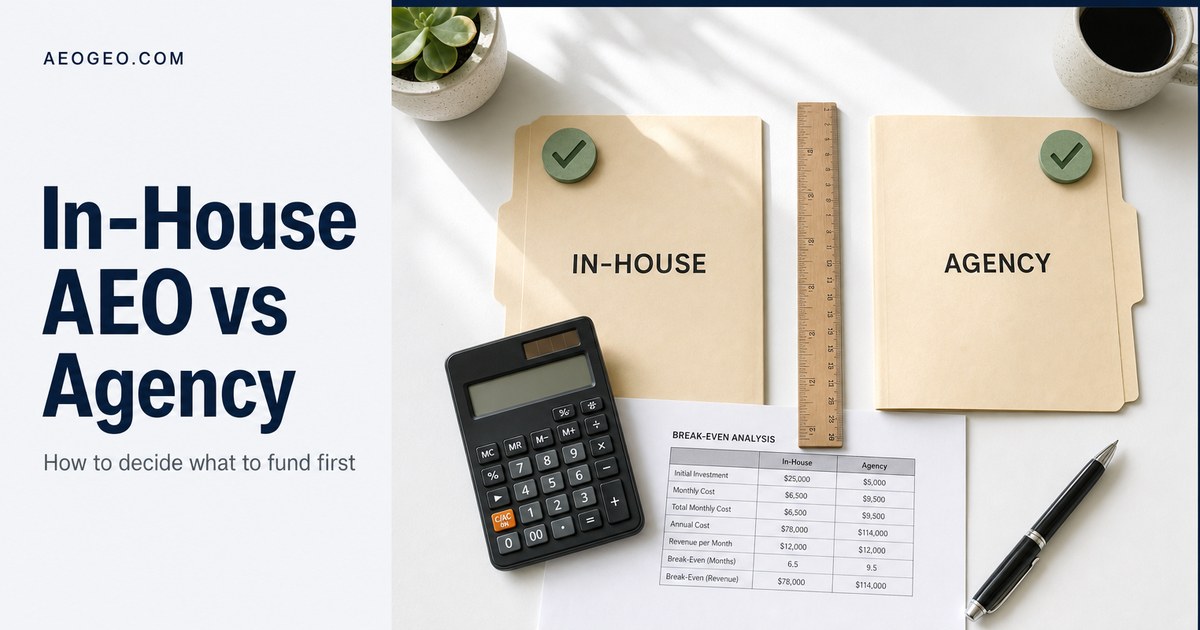
At $18K - $36K out before a verdict, an agency retainer is a real commitment. Here are the two gates to clear and the break-even arithmetic to run first.
Position-1 CTR fell 58% when AI Overviews appear. Learn what AEO and GEO add to SEO, where they overlap, and how to frame the budget case for a CFO.
At $18K - $36K out before a verdict, an agency retainer is a real commitment. Here are the two gates to clear and the break-even arithmetic to run first.
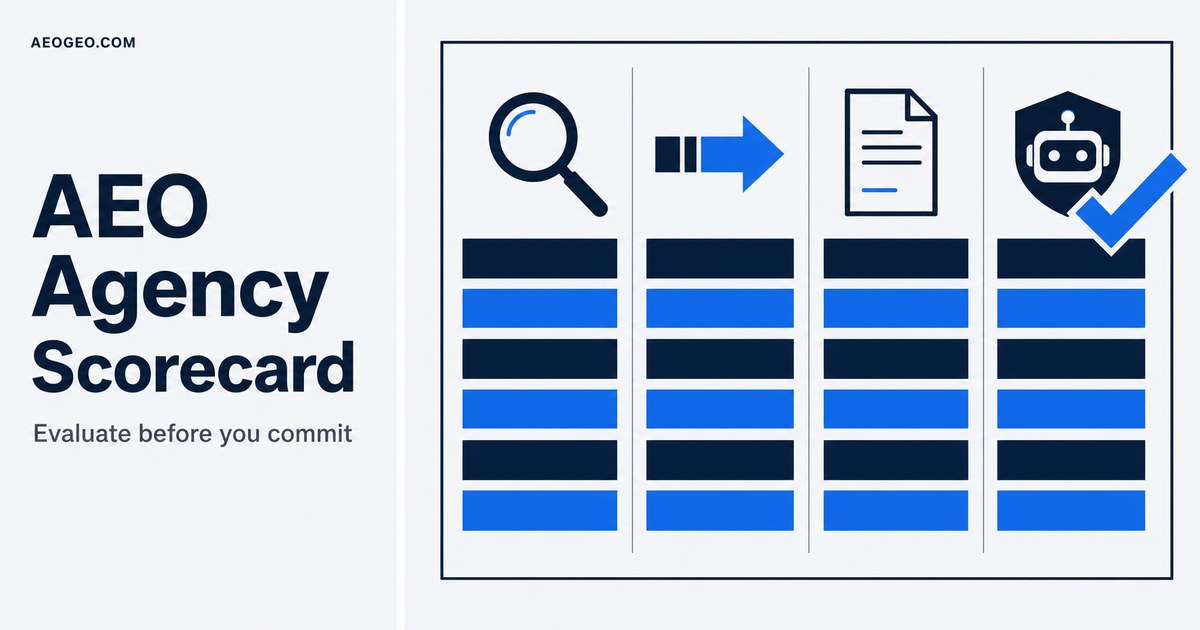
A vendor-neutral scorecard for B2B SaaS revenue leaders: four criteria that separate credible AEO/GEO agencies from rebranded SEO retainers.
AI visibility tools count citations but miss pipeline impact. What to look for, what every tool category misses, and how to evaluate them for B2B SaaS.
Request a quote and our experts will contact you within 24 hours with tailored solutions and pricing.
aeogeo.app
Last updated: Oct 20, 2026
By Ishan Manchanda, Co-Founder, GrowthSpree | Last updated: October 13, 2026
Ishan Manchanda is co-founder of GrowthSpree, a B2B SaaS marketing consultancy founded in 2017 that has managed $60M+ in ad spend across 300+ B2B SaaS companies. His work on demand generation and go-to-market strategy has been featured in Silicon Valley Times, SaaS Mag, and the Unbounce podcast. GrowthSpree operates Salient, a managed AEO/GEO service. That affiliation is disclosed wherever Salient or GrowthSpree data appears in this article.
Answer engine optimization (AEO) is the practice of structuring content so that AI systems - including Google AI Overviews, ChatGPT, and Perplexity - cite it in generated answers, measuring citation frequency rather than keyword ranking position.
If your team still measures AI search success by rankings, the measurement model is wrong. Position-1 click-through rates fell 34.5% when AI Overviews appeared in April 2025 and 58% by December 2025 (Ahrefs, 2026). A page can rank first and still be invisible to the majority of visitors on queries where an AI summary appears. The gap between those two facts is exactly where AEO and GEO live.
This guide draws the specific line between what traditional SEO already handles and what answer engine optimization and generative engine optimization (GEO) add. It covers definitions, the statistical case, the overlap and the break, content tactics with evidence behind them, and the numbers a CMO or Head of SEO can put in front of a skeptical CFO.
Key Takeaways
- Answer engine optimization (AEO) targets citation frequency in AI-generated answers, not keyword rankings. Ranking and citation are now structurally separate visibility layers.
- Position-1 CTR fell 58% when Google AI Overviews appear (Ahrefs, December 2025). Users clicked a result in only 8% of visits with an AI summary present, versus 15% without (Pew, March 2025).
- 51% of B2B software buyers start research with an AI chatbot, up from 29% a year earlier (G2, March 2026, n=1,076). Being absent from the cited answer means being absent from the buyer's shortlist.
- AEO and SEO share a technical foundation: crawlability, content quality, and domain authority serve both. The break is in what you measure and how you structure content.
- Four tactics have verified evidence heading into 2026: long-form recently updated content, expert quotations and statistics, brand mention building, and explicit per-bot crawler access policies.
Answer engine optimization (AEO) is the practice of structuring and evidencing content so that AI systems - including Google AI Overviews, ChatGPT search, Perplexity, Copilot, and Gemini - select and surface it as a cited answer. The goal is citation frequency and answer fit, not keyword ranking. AEO extends traditional SEO by adding three explicit requirements: AI crawler access to the page, an extractable answer to the exact question, and trust signals sufficient for an AI to cite the source.

Traditional SEO is the practice of optimizing web pages to rank in keyword-based search engine results pages (SERPs), measured primarily by ranking position, organic sessions, and click-through rate. It has been the dominant model for organic search since the late 1990s.
AEO targets a different output: whether your content appears as the cited source inside an AI-generated response. That response may appear on Google, in ChatGPT, in Perplexity, in Microsoft Copilot, or in Claude. The user may never click through to your site. The question AEO answers is not "Do we rank?" but "Are we cited?"
The distinction matters because the two outputs are increasingly divergent. "Citation overlap with the organic top 10 fell from roughly 76% in mid-2025 to between 17% and 54% in early 2026" (Slate HQ Editorial, 2026). A high organic rank is no longer a reliable proxy for citation presence.
AEO is not a replacement for SEO. The technical foundation - crawlable pages, strong domain authority, clear content structure - serves both. The addition is a distinct measurement layer and a distinct content design standard.
Generative engine optimization (GEO) is the discipline of optimizing content so that large language models incorporate it when generating answers, summaries, and recommendations across AI-native platforms including ChatGPT, Perplexity, Claude, Gemini, and Copilot. The GEO software market was estimated at USD 390 million in 2025 and is projected to reach USD 4,250 million by 2032 at a 41% CAGR (MarketsandMarkets, 2025). GEO addresses the broader content environment AI models draw on when composing any generated output.

GEO and AEO are closely related terms used with different emphases across the industry:
In practice, the tactics overlap almost entirely. Both require crawlable, answer-first content with corroborating authority signals. The market categorizes them together for budget and measurement purposes, and that framing is used throughout this guide.
Zero-click influence is the effect an AI-generated answer has on buyer decisions before any click to a website occurs. When a B2B buyer asks ChatGPT which vendors to evaluate in a category and a brand is absent from the answer, the loss is invisible to analytics: no click, no form fill, no lead record - but the shortlist has already been set. That is the commercial case for both AEO and GEO beyond the click-through-rate argument.
The SEO ranking model fails to predict traffic on AI-exposed queries because click behavior has structurally changed. Ahrefs' December 2025 study of 300,000 keywords found AI Overviews correlate with a 58% lower average CTR for the position-1 organic result. Pew Research Center's March 2025 behavioral study of approximately 69,000 real queries found users clicked a result in only 8% of visits with an AI summary present, versus 15% without - a 47% relative reduction.

"As of December 2025, AI Overviews reduce the organic click-through rate for position one content by 58%." (Ryan Law, Ahrefs, 2026)
The CTR decline is not uniform across positions. Ahrefs' data shows the steepest effect at position 1 (down 58% (Ahrefs, December 2025)), moderating through position 5 (down 32.6% (Ahrefs, December 2025)), and reaching position 10 (down 19.4% (Ahrefs, December 2025)). No position is unaffected.
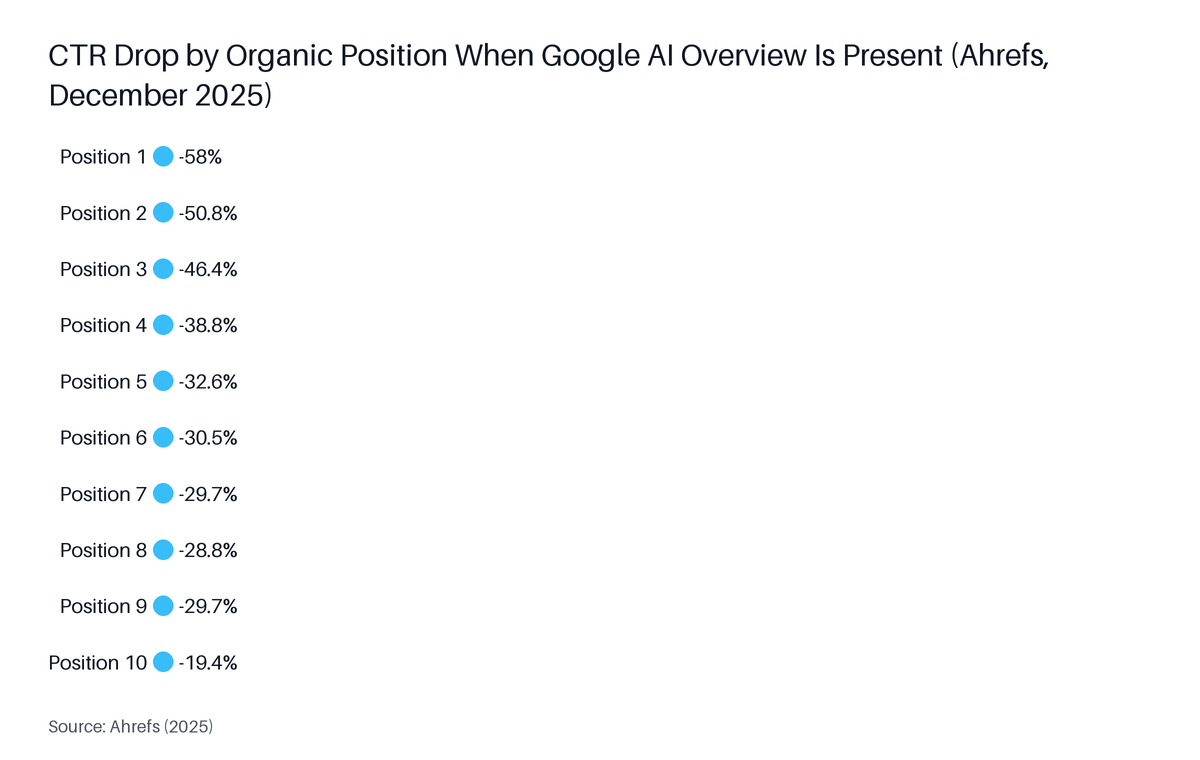
Source: Ahrefs, 2025
The practical implication: a team reporting weekly organic ranking data as its primary AI search KPI is measuring a signal that tells it progressively less about whether content reaches buyers. Impressions can hold or rise while clicks - and buyer exposure - fall.
Google AI Overviews are the most measurable surface, but the zero-click dynamic extends across platforms. Pew's study found zero-click sessions rose to 26% of all sessions when an AI summary was present (Pew Research Center, via Omnibound, 2025). On Google AI Mode, the zero-click rate is reported at 93% (Omnibound, 2026). A ranking report captures none of this.
This pattern - impressions up, clicks down - is the signature of AI summary expansion on a query set. The page is still being found; the user is being answered before they arrive. Teams that report this pattern to a CFO without a citation-frequency metric alongside it have no explanation for the underlying cause and no lever to pull.
Google AI Overviews separate citation presence from organic rank as distinct visibility dimensions. AI Overviews appeared in approximately 25.11% of US searches in early 2026, up from 13.14% in March 2025 (Conductor, reported at Omnibound, 2026), while reaching 2 billion monthly users (confirmed at Alphabet's Q2 2025 earnings). Cited brands earn approximately 35% more organic clicks than uncited results on the same SERP (Seer Interactive, reported at Slate HQ, 2025-2026). A brand can hold a first-page ranking and still be absent from the answer seen by most visitors.
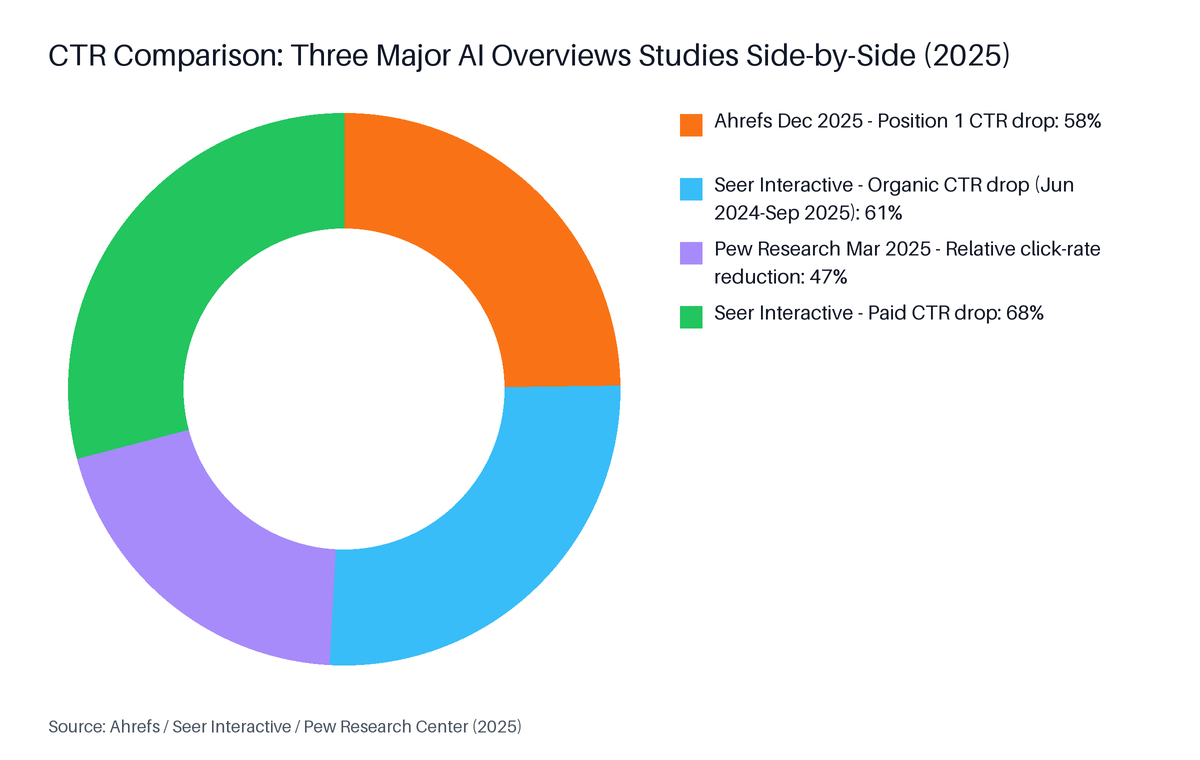
Source: Ahrefs / Seer Interactive / Pew Research Center, 2025
Seer Interactive's portfolio study of 42 organisations found organic CTR dropped 61% and paid CTR dropped 68% on queries with AI Overviews (Seer Interactive, reported at Slate HQ, 2025-2026). There is also a measurable upside to citation: AISOS/Sistrix found a 340% lift in impressions for cited versus non-cited sites on the same query (AISOS/Sistrix, reported at Slate HQ, 2025-2026). Citation is not only a defensive necessity; it is an asymmetric visibility advantage.
Google AI Overviews apply the same E-E-A-T (Experience, Expertise, Authoritativeness, and Trustworthiness) framework as organic search, but content structure requirements differ:
| Ranking factor | Weight for organic top 10 | Weight for AI Overview citation |
|---|---|---|
| Keyword relevance | High | Moderate |
| Backlink authority | High | Moderate |
| Answer-first structure (extractable prose block) | Low | High |
| Expert attribution and cited statistics | Low - moderate | High |
| Content recency (updated in last 12 months) | Moderate | High |
| Brand mention volume | Moderate | High (0.664 correlation) |
The structural implication: a page optimized only for keyword ranking and backlink authority will underperform on AI Overview citation even if it ranks in the top three organic results.
Not all AI platforms weight signals the same way:
A single content strategy calibrated only to Google's AI Overviews will leave gaps on other platforms where B2B buyers actively research.
Generative engine optimization (GEO) targets three outputs that traditional SEO does not optimize for: citation frequency inside AI-generated answers, answer fit for synthesised responses rather than ranked document lists, and zero-click influence on buyer shortlisting. Peer-reviewed research from Princeton University, Georgia Tech, the Allen Institute for AI, and IIT Delhi (KDD 2024) found expert quotations, statistics, and cited sources can lift AI source visibility by over 40% - outcomes keyword optimization does not produce.

"Including citations, quotations from relevant sources, and statistics can significantly boost source visibility, with an increase of over 40% across various queries." (Aggarwal et al., Princeton University / Georgia Tech / Allen Institute for AI / IIT Delhi, KDD 2024)
The optimization techniques that most improve AI citation frequency - and the approximate visibility lift each provides per the Princeton KDD 2024 study - are shown below. Note the negative signal: keyword stuffing correlates with an 8% decrease in AI source visibility.
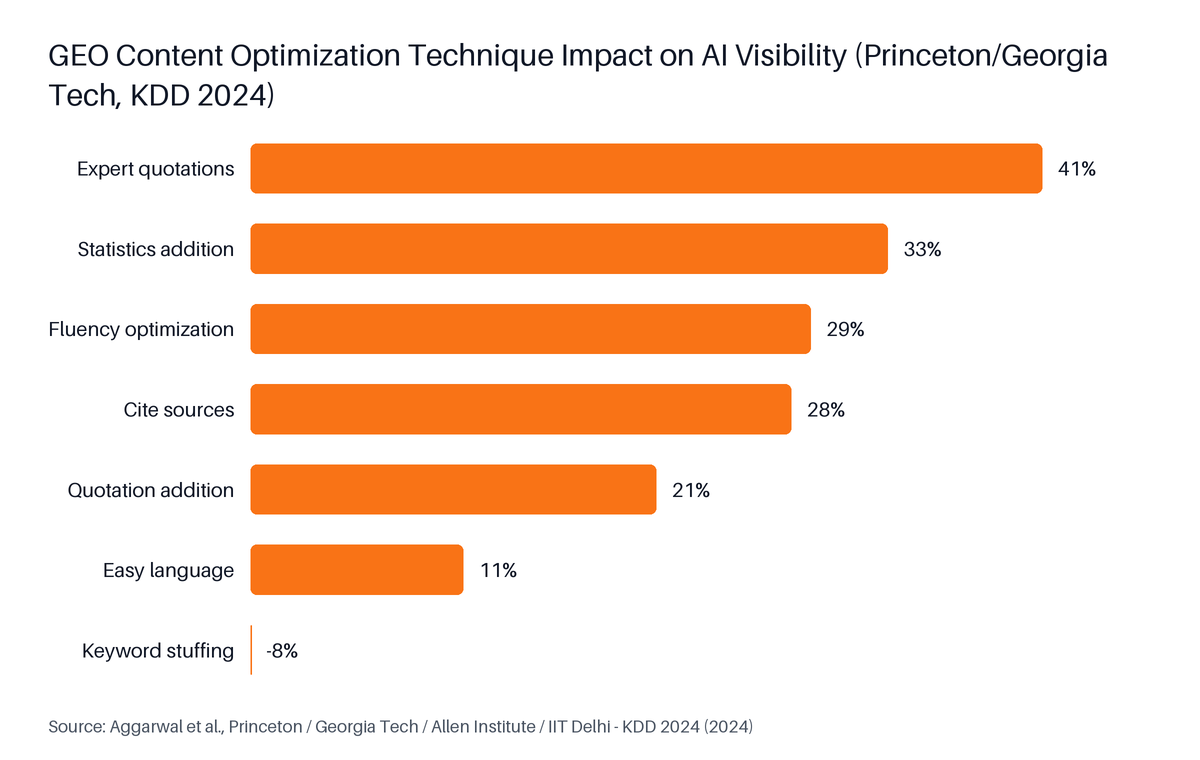
Source: Aggarwal et al., Princeton / Georgia Tech / Allen Institute / IIT Delhi — KDD 2024, 2024
The tactics that inflated rankings in older SEO approaches actively harm citation probability in AI answer engines. That is the clearest structural break between the two disciplines.
The commercial reason GEO matters is the pace of behavioral change. 51% of B2B software buyers now start their research with an AI chatbot, up from 29% a year earlier (G2, March 2026, n=1,076). 94% of business buyers use AI at some point during the buying process (Forrester, 2026). 69% of B2B buyers chose a different vendor than they had planned because of a chatbot recommendation (G2, March 2026, n=1,076).
That last figure is the CFO metric: the shortlist is being set by AI answers before the first sales call. A brand absent from those answers is not losing clicks - it is losing opportunities that never appear in the CRM.
AEO, GEO, and traditional SEO share a common technical and authority foundation: pages that AI engines cite are almost always crawlable, well-structured, and backed by domain authority. The break comes at measurement and content design. SEO measures keyword rankings and organic sessions. AEO and GEO measure citation frequency - how often a page is cited across a fixed prompt set repeated over multiple runs - and zero-click influence on buyer decisions. Brand mentions correlate 0.664 with AI citation probability, compared to 0.218 for backlinks (Ahrefs research team, 2025).
Share of answers is the AEO/GEO equivalent of keyword ranking: the proportion of a defined prompt set on which a brand appears as a cited source, measured across multiple runs to account for non-determinism. AI recommendation lists almost never repeat across runs (SparkToro, 2026), which is why a single spot-check is not a measurement. Frequency ranges - cited in x of N runs - are the correct reporting unit.
"Brand mentions correlate 0.664 with AI citation probability compared to 0.218 for backlinks." (Ahrefs research team, 2025)
| Task | Serves SEO | Serves AEO/GEO | Typical owner |
|---|---|---|---|
| Crawler access (robots.txt, CDN bot rules) | Yes | Yes - prerequisite | Engineering / SEO |
| Page speed and Core Web Vitals | Yes | Partially | Engineering |
| Backlink acquisition | Yes | Partially (0.218 citation correlation) | SEO / Content |
| Brand mention building | Partially | Yes (0.664 citation correlation) | PR / Content / PMM |
| Answer-first content structure | No | Yes | Content / SEO |
| Expert quotation and statistics in content | No | Yes (+40%, +33% lift per KDD 2024) | Content |
| Citation frequency tracking (prompt set × runs) | No | Yes | SEO / RevOps |
| Per-bot crawler access policy | No | Yes | Engineering |
| Self-reported attribution (AI assistant field) | No |
The overlap is real and substantial. The SEO budget does not need to be replaced. The incremental investment is in the lower half of this table: answer-fit content design, brand mention corroboration, citation-frequency measurement, and crawler access management.
Three conditions must hold simultaneously for a page to be cited: AI crawlers must fetch and parse it, the content must answer the exact question in an extractable block, and the source must carry corroborating trust signals. Princeton, Georgia Tech, and the Allen Institute (KDD 2024) found expert quotations lift AI source visibility by over 40% and statistics by 33%. Articles over 2,900 words are 59% more likely to be cited by ChatGPT than content under 800 words (SE Ranking, 2025, reported at eLandz).

The Failure-Point Test is a three-part diagnostic for any page that should be cited but is not:
Use these as a quality check before publishing or auditing existing pages:
Four tactics have verified evidence heading into 2026: long-form recently updated content (articles over 2,900 words are 59% more likely to be cited, and 82% of ChatGPT-cited pages were updated in 2025, per SE Ranking, 2025, reported at eLandz); expert quotations and statistics (Princeton KDD 2024: 40%+ and 33% visibility lifts); brand mention building (Ahrefs 2025: 0.664 vs 0.218 correlation versus backlinks); and explicit per-bot crawler access policies, which became a prerequisite after Cloudflare began blocking AI crawlers by default in July 2025.
Not every tactic proposed in 2025 has been validated. Teams should distinguish proven from speculative before committing budget:
| Tactic | Evidence status (as of October 2026) |
|---|---|
| Answer-first content blocks | Proven - directly supported by KDD 2024 citation lift data |
| Expert quotations and statistics | Proven - KDD 2024: 40%+ and 33% lifts |
| Long-form content (2,900+ words) | Proven - SE Ranking, 2025: 59% higher citation probability |
| Brand mention building | Proven - Ahrefs, 2025: 0.664 correlation |
| Crawler access (robots.txt, CDN) | Proven - prerequisite; binary effect on citation |
| llms.txt adoption | Speculative - no verified citation lift demonstrated at scale |
| Schema markup as a citation driver | Speculative - helps structured data surfaces; citation effect unconfirmed |
| Publishing cadence alone | Not sufficient - volume does not fix access or trust failures |
The Citation-to-Pipeline Ladder provides a structured way to track progress across five measurable rungs: crawler access confirmed, citation frequency established on a fixed prompt set, AI-referred sessions captured in GA4, AI-sourced leads identified via self-reported attribution, and AI-influenced pipeline tracked in the CRM. Each rung has a distinct measurement method. Reporting a number without the method is not a defensible metric for a CFO review.
Six figures make the budget argument for generative engine optimization: position-1 CTR fell 58% when AI Overviews appear (Ahrefs, December 2025); users clicked in only 8% of visits with an AI summary versus 15% without (Pew Research Center, via Omnibound, 2025); AI-referred visitors convert at 4.4 times the organic rate (Previsible, 2025, via Omnibound); cited brands earn approximately 35% more organic clicks on the same SERP (Seer Interactive, via Slate HQ, 2025-2026); and 51% of B2B software buyers start with an AI chatbot (G2, March 2026, n=1,076).
Our data: Salient by GrowthSpree (GrowthSpree's managed AEO/GEO service, launched September 2026) reports 48,800 citations and $165,000+ pipeline across its clients (Salient pitch deck; vendor-reported). aeogeo.com is a GrowthSpree property, and this affiliation is disclosed.
The 4.4× conversion rate for AI-referred visitors is the figure most CMOs find counterintuitive. The explanation is intent: a buyer who arrives from an AI-cited answer has already been pre-sold on the category and has self-selected the brand as worth investigating. Seer Interactive's platform-level study found ChatGPT LLM traffic specifically converted at a 15.9% rate versus 1.76% for Google organic in the same portfolio (Seer Interactive, via Omnibound, 2025).
The GEO software market projects from USD 390 million in 2025 to USD 4,250 million by 2032 at a 41% CAGR (MarketsandMarkets, 2025), giving the budget conversation a market-sizing anchor for executive and board presentations.
The budget case has two sides: the upside (citation converts better) and the downside (absent brands lose shortlist position). An illustrative Revenue-at-Risk Model built on observed benchmarks: at 30% organic share of pipeline and 60% of those queries showing an AI summary, a 34.5% click erosion removes approximately 6.2% of total pipeline. At 58% erosion, the figure rises to 10.4%. At 40% organic share and 80% exposed queries: 11.0% and 18.6% respectively. These are illustrative models, not forecasts - all outputs should be labeled as such in any internal business case.
The AEO and GEO investment case described here applies to B2B companies with an active, crawlable website that buyers research before speaking to sales. It does not apply to businesses without a maintained web presence, companies selling through app stores or marketplaces, or B2C businesses. AI referral traffic measured at 0.1% of referral traffic across 35,000 sites (Ahrefs) yet approximately 3% of Ahrefs' own conversions - the gap is a dark funnel problem, not evidence the channel is small.
Two limits on the statistical claims in this guide deserve explicit acknowledgment:
Answer engine optimization (AEO) is the practice of structuring and evidencing content so that AI systems - including Google AI Overviews, ChatGPT search, Perplexity, Copilot, and Gemini - select and surface it as a cited answer. The goal is citation frequency and answer fit, not keyword ranking. AEO extends traditional SEO by adding three requirements: AI crawler access, an extractable answer to the exact question, and trust signals sufficient for an AI to cite the source.
Answer engine optimization and traditional SEO share the same technical foundation - crawlability, content quality, and domain authority - but diverge at the output level. SEO optimises for a ranked position in a list of results. AEO optimises for selection as the cited answer in a synthesised AI response, often with no click at all. When Google AI Overviews appear, position-1 CTR drops 58% (Ahrefs, 2026). Ranking alone no longer predicts traffic on AI-exposed queries.
Google AI Overviews and Google AI Mode are the primary surfaces where AEO outcomes are tested at scale. AI Overviews appeared in approximately 25.11% of US searches in early 2026, up from 13.14% in March 2025 (Conductor, via Omnibound, 2026). "Citation overlap with the organic top 10 fell from roughly 76% in mid-2025 to between 17% and 54% in early 2026" (Slate HQ, 2026), meaning ranking and citation now require separate optimization strategies.
Three conditions must hold simultaneously: the AI crawler must fetch and parse the page; content must answer the exact question in an extractable block; and the source must carry corroborating trust signals. Princeton, Georgia Tech, and the Allen Institute (KDD 2024) found expert quotations lift AI source visibility by over 40% and statistics by 33%. Articles over 2,900 words are 59% more likely to be cited by ChatGPT than content under 800 words (SE Ranking, 2025).
Google AI Overviews shifts the optimization target from a ranked position to a cited source inside a synthesised answer. As of December 2025, AI Overviews correlate with a 58% lower position-1 CTR (Ahrefs, 2026). Citation overlap with organic top-10 results fell from roughly 76% in mid-2025 to between 17% and 54% in early 2026 (Slate HQ, 2026). A page can rank well and still be absent from the answer seen by most visitors.
Generative engine optimization (GEO) is important because 51% of B2B software buyers now start with an AI chatbot, up from 29% a year earlier (G2, March 2026, n=1,076), and 94% use AI during buying (Forrester, 2026). The GEO software market projects from USD 390 million in 2025 to USD 4,250 million by 2032 at a 41% CAGR (MarketsandMarkets, 2025). A brand absent from AI-generated answers risks losing shortlist position before any sales contact.
In practice, AEO works through three steps: ensuring AI crawlers can access and parse the page (robots.txt, server-side rendering, CDN bot rules); structuring content so the answer appears in an extractable prose block within the first 100-150 words of each section; and building trust through brand mentions, expert attribution, and cited statistics. Citation frequency - tracked as how often a page is cited across a fixed prompt set run multiple times - is the primary metric, not ranking position.
Four strategies have evidence: long-form recently updated content (articles over 2,900 words are 59% more likely to be cited, and 82% of ChatGPT-cited pages were updated in 2025, per SE Ranking, 2025); expert quotations and statistics (Princeton KDD 2024: 40%+ and 33% visibility lifts); brand mention building (Ahrefs 2025: 0.664 vs 0.218 correlation versus backlinks); and explicit per-bot crawler access policies since Cloudflare began blocking AI crawlers by default in July 2025.
Six figures carry the argument: position-1 CTR fell 58% when AI Overviews appear (Ahrefs, 2026); users clicked in only 8% of visits with an AI summary versus 15% without (Pew, 2025); AI-referred visitors convert at 4.4 times the organic rate (Previsible, 2025); cited brands earn 35% more organic clicks on the same SERP (Seer Interactive, 2025-2026); 51% of B2B buyers start with an AI chatbot (G2, March 2026); and GEO market growth runs at 41% CAGR (MarketsandMarkets, 2025).
Generative engine optimization (GEO) targets citation frequency in AI-generated answers, answer fit for synthesised responses, and zero-click influence on buyer shortlisting - none of which traditional SEO measures. The overlap is real: crawlability, domain authority, and E-E-A-T content quality serve both disciplines. The break is at measurement (citations per prompt set, not rankings) and content structure (extractable answer blocks and expert quotations, not keyword density).
Answer engine optimization and generative engine optimization are not replacements for traditional SEO. They are an additional visibility layer, built on the same technical and authority foundation, with a distinct measurement model and a distinct content design standard. The core argument is precise: ranking and citation have separated. A page cited in a Google AI Overview earns 35% more organic clicks than an uncited result on the same page. A page that ranks first but is absent from the AI Overview loses 58% of its expected clicks.
Here are five actions to take this week:
Get the weekly brief - AI search platform changes, CTR benchmarks, and citation tactics for B2B revenue teams, published weekly at aeogeo.app.
Related reading (links will be added when these articles publish):
Disclosure: aeogeo.com is operated by GrowthSpree, a B2B SaaS marketing consultancy. GrowthSpree operates Salient, a managed AEO/GEO service. Where GrowthSpree or Salient data is cited, the source and affiliation are identified. All break-even and revenue-at-risk figures in this article are illustrative models, not financial advice.
Last updated: October 13, 2026
© 2026 aeogeo.app All rights reserved.


| Yes |
| RevOps |