Request a quote and our experts will contact you within 24 hours with tailored solutions and pricing.
aeogeo.app
Last updated: Oct 15, 2026
AI Search Visibility Tools: How to Pick One That Gives You Boardroom-Ready Numbers
By Ishan Manchanda, Co-Founder, GrowthSpree - October 13, 2026
AI search visibility tools are platforms that track how often and where a brand is cited in AI-generated answers across ChatGPT, Perplexity, Google AI Mode and Gemini, and the choice of tool determines whether a CMO walks into a finance review with a defensible frequency range or an anecdote.
The trigger is familiar. An exec screenshots a competitor being cited in a ChatGPT answer and drops it in Slack. The question that follows is not "interesting, I wonder why" - it is "which tool catches that continuously?" The answer depends on five criteria: sampling methodology, multi-platform coverage, B2B SaaS fit, attribution path, and entry price. A tool that scores well on only one of these produces a number no CFO will fund a program around.
This guide applies those five criteria as a scorecard. Every assessment uses primary sources. GrowthSpree and its managed AEO/GEO service, Salient by GrowthSpree, are subject to the same scorecard as any other vendor - affiliation is disclosed and the criteria are identical.
Key Takeaways
A single-run prompt check is not AI search visibility measurement. AI recommendation lists almost never repeat across runs (SparkToro, 2026), so one check cannot distinguish a frequency gap from random variation.
The finance-defensible number is citation frequency expressed as X of N runs over time, compared against a fixed competitor set on the same prompt set.
51% of B2B software buyers now start research with an AI chatbot (G2, March 2026, n=1,076) - the shortlist is often set before a sales rep is contacted.
An AI search visibility audit has a fixed order: confirm crawler access first, then check citation frequency, then apply the Failure-Point Test to individual pages.
A 25-person team can start without a paid subscription using a manual prompt set, a GA4 AI-referral channel group, and a self-reported attribution field.
Which tools track brand visibility across AI search engines and flag when coverage drops unexpectedly?
AI search engine visibility tracking tools monitor how often a brand is cited in AI-generated answers across ChatGPT, Perplexity, Google AI Mode and Gemini, then alert teams when citation frequency falls below a threshold. Tools worth evaluating run repeated prompt sets rather than a single pass - a tool that checks one prompt once and reports "present" or "absent" has no baseline to compare against and cannot flag any drop.
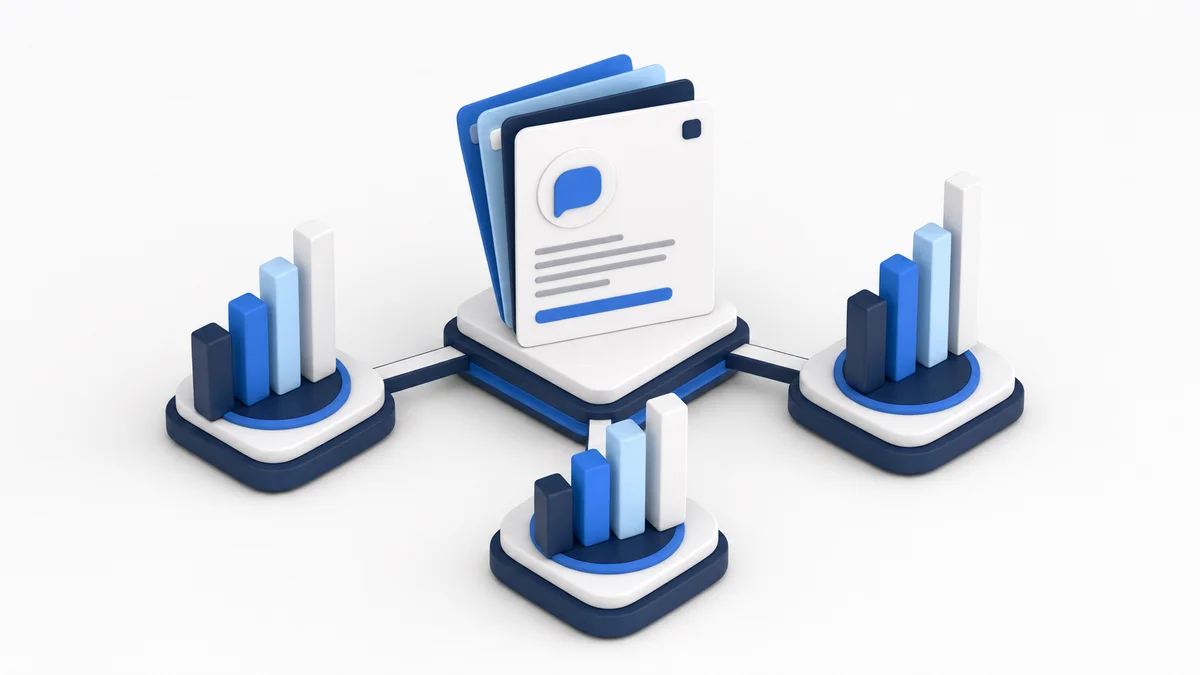
Isometric 3D scene of stacked prompt cards and citation frequency bars across AI platform nodes
An alert threshold only carries meaning when the underlying measurement has statistical weight. That requires:
A fixed prompt set of at least 20 queries, matching buyer phrasing across awareness, consideration and evaluation stages.
A minimum of 30 runs per query per reporting period.
Results stored with timestamps so week-over-week frequency comparison is possible.
Named competitors tracked on the same prompt set, so a drop in your frequency is distinguishable from a platform-wide change.
What "flagging a drop" actually means
A tool that sends an alert when your brand disappears from a single prompt run produces noise, not signal. A tool that alerts when your 30-run citation frequency falls by more than 10 percentage points week over week produces an actionable signal. The alert specification in a tool's configuration is a direct indicator of how rigorous its sampling methodology is.
Which brand monitoring tools cover AI search specifically, not just social and traditional web mentions?
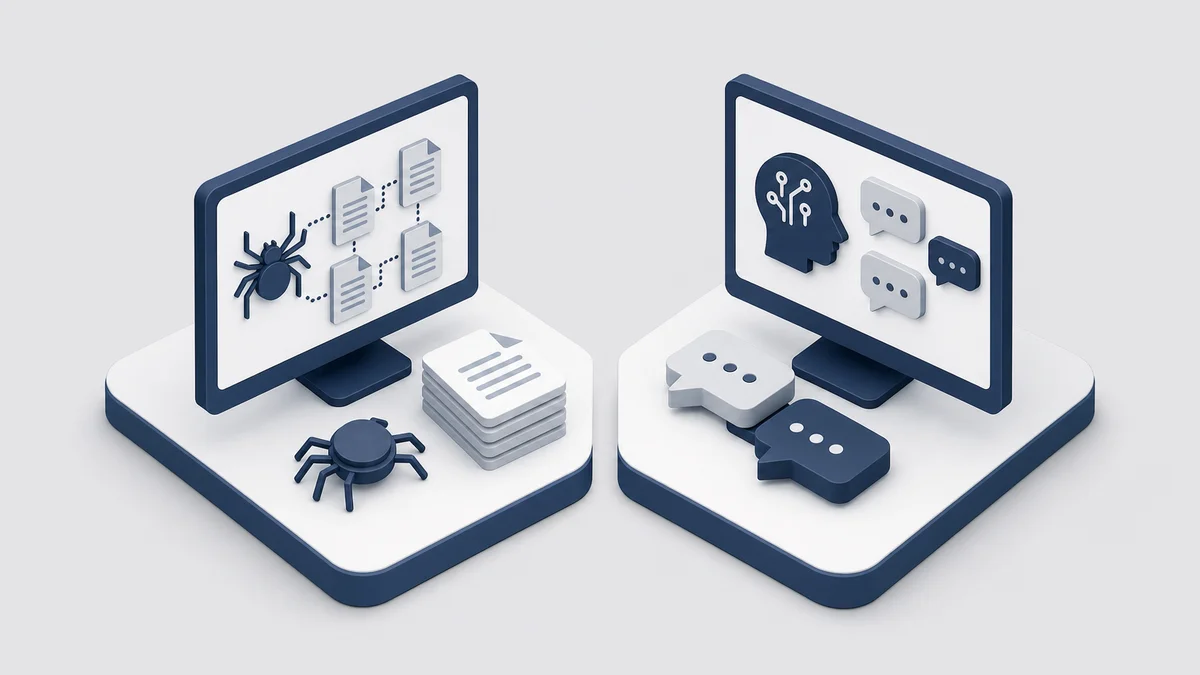
Brand monitoring tools built for AI search send structured prompts to AI platforms and record whether the brand appears in the synthesized answer - not whether it appears on a web page. Traditional brand monitoring crawls published content. AI-specific monitoring probes the output layer of ChatGPT, Perplexity and Gemini directly, where 51% of B2B software buyers now start their research (G2, March 2026, n=1,076), up from 29% a year earlier.
Isometric illustration of a two-column comparison tile: AI-specific monitoring versus traditional brand monitoring
The practical difference for a B2B marketing team: a web-mention tool reports that your brand appeared on a third-party review site. An AI-specific tool reports that when a buyer typed "best project management software for remote engineering teams" into ChatGPT, your brand appeared in 22 of 50 runs last week and 31 of 50 the week before.
The two questions a B2B team needs answered
Question
Traditional brand monitoring
AI-specific monitoring
Is our brand mentioned on the web?
Yes - crawls published pages
Indirectly - citations link to pages
Are we cited when buyers ask AI?
No
Yes - direct prompt testing
Can we compare against competitors?
Yes - web share of voice
Yes - share of AI answers on same prompt set
Does it trend over time?
Yes
Only if the tool stores repeated run data
What software optimizes our content so AI search engines surface and cite it consistently?
AI search visibility optimization software diagnoses the three reasons a page is not cited: the AI crawler cannot fetch or parse it, the page does not answer the exact question in an extractable block, or the source lacks third-party corroboration. Software that addresses all three failure points gives content teams a ranked fix list. Tools that only surface competitor citations without diagnosing page-level failure do not move citation frequency on their own.
The diagnostic sequence matters:
Crawler access is the gate. A page blocked by robots.txt, a CDN WAF rule, or client-side rendering cannot be cited regardless of content quality. Cloudflare began blocking AI crawlers by default in July 2025 (Cloudflare), so teams running Cloudflare without reviewing bot-access rules may be invisible without knowing it.
Answer fit is the extraction test. AI engines lift 40-80 word passages that directly answer a query. A page that buries its answer in paragraph five of a 2,000-word article will not be extracted, even if it ranks first.
Source trust is the corroboration requirement. AI engines weight sources cited by other trusted publications. A page with no third-party references pointing to it starts at a structural disadvantage.
Software that runs all three diagnostics and ranks fixes by priority is more valuable than a tool that scores only one dimension.
What are the best AI search visibility tools for tracking citations across ChatGPT and Perplexity?
The strongest AI search visibility tools for tracking citations across ChatGPT and Perplexity run the same prompt set repeatedly and report a frequency range, cover both platforms in a single workflow, attribute each citation to a source URL rather than noting brand presence only, and allow a fixed competitor set for share-of-answers comparison. Users clicked a result in 8% of visits with an AI summary versus 15% without (Pew Research Center, 2025) - the citation, not the click, is the first commercial signal worth tracking.
A tool missing any of these four characteristics produces data a team can observe but cannot act on or defend:
Without repeated runs: no frequency range, no trend, no statistical weight.
Without multi-platform coverage: a competitor cited on ChatGPT but not Perplexity looks equally visible in single-platform reports.
Without source URL attribution: the team cannot identify which pages to improve.
Without competitor comparison: a frequency of 28 of 50 means nothing without knowing the competitor sits at 41 of 50.
We are 25 people - what is the minimum-cost way to start tracking AI search visibility?
A 25-person team can start tracking AI search visibility without a paid subscription. Build a fixed set of 20 queries matching how buyers describe their problem. Run each five times across ChatGPT, Perplexity and Google AI Mode, recording citations and source URLs. Set up a GA4 custom channel group for chatgpt.com, perplexity.ai and gemini.google.com to catch inbound AI-referred sessions. Add "AI assistant" to the lead form's self-reported attribution field. This baseline costs staff time, not a retainer.
The minimum-cost approach has real limits: five runs per query provides no statistical confidence, manual recording introduces error, and the team receives no automated alerts when frequency drops. The value of starting manually is establishing a baseline - four weeks of manually collected frequency data gives a comparison point that makes a paid tool's output meaningful when one is eventually adopted.
When to move from manual to a paid tool
Signal
Threshold to act
Prompt set size
More than 30 queries - manual becomes unmanageable
More than 3 competitors - manual tracking error accumulates
Board reporting
CFO asks for a trend line - manual data is too inconsistent to present
Our organic clicks fell 30% while impressions held - where do we start an AI search visibility audit?
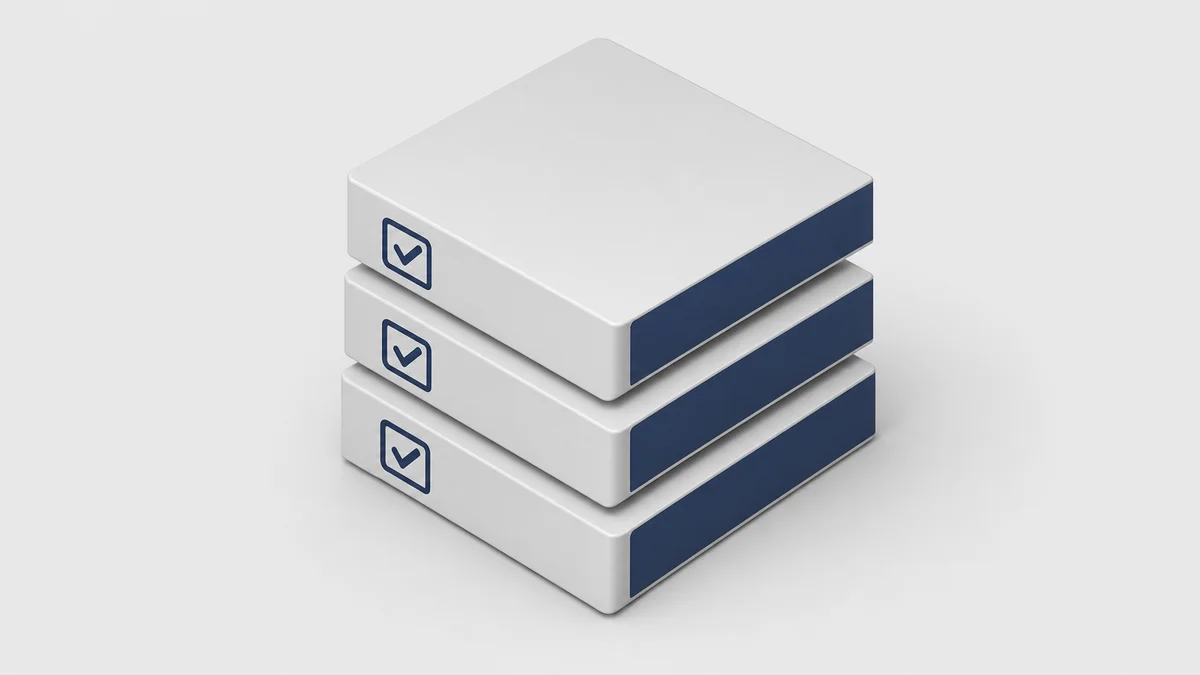
An AI search visibility audit starts with three checks in sequence. First, confirm AI crawlers can access the site - review robots.txt and CDN bot-blocking rules, because Cloudflare began blocking AI crawlers by default in July 2025 (Cloudflare). Second, run a 20-prompt citation test across ChatGPT and Perplexity. Third, apply the Failure-Point Test to the five pages most likely to be cited: can the machine read it, does it answer the exact question, is the source trusted. Fix access before optimizing content.
Isometric audit checklist tile with three labeled layers: crawler access, answer fit, source trust
When impressions hold but clicks fall, the pattern is consistent with AI Overviews absorbing the query without returning a click. Position-one click-through rate fell 34.5% when AI Overviews showed in Ahrefs' April 2025 dataset and 58% in the February 2026 dataset. An audit that starts with content optimization instead of crawler access risks spending weeks on copy changes while a fundamental access problem remains unresolved.
Audit sequence in practice
Pull server logs and identify which AI bots - OAI-SearchBot, PerplexityBot, ClaudeBot - accessed the site in the last 30 days and which paths they reached.
Cross-reference against the pages you intend to be cited. A page with zero AI-bot visits in 30 days is structurally excluded from citation.
Run the 20-prompt citation test and record frequency by query and by platform.
Apply the Failure-Point Test to any page with zero citations despite AI-bot access.
An exec screenshotted a competitor being cited and we weren't - what tool surfaces that gap continuously?
A single screenshot is a one-run snapshot with no statistical weight. AI brand visibility optimization tools that surface competitive gaps continuously run the same prompt set on a fixed cadence and report citation frequency as a range: your brand cited in 18 of 50 runs, the competitor in 37 of 50. That frequency range replaces the screenshot as the number worth bringing to a leadership discussion, because AI recommendation lists almost never repeat across runs (SparkToro, 2026).
The tool capabilities to evaluate for this scenario:
Competitor tracking on the same prompt set: the gap only becomes visible when both brands are scored on identical queries in the same session.
Historical comparison: the frequency gap this week versus four weeks ago shows whether the competitor is pulling ahead or whether this is noise.
Source URL attribution on competitor citations: knowing which pages the competitor is cited from reveals the content or technical advantage to close.
Salient by GrowthSpree data (vendor-reported, September 2026): Salient - the managed AEO/GEO service operated by GrowthSpree, which also operates aeogeo.com - reports 48,800 citations and $165,000+ in pipeline across its client base since launch, on engagements priced at $999/month and $1,500/month (Salient pitch deck). The same five-criteria scorecard on this page applies to Salient equally.
What tool tracks AI citation frequency over time rather than a single pass on one platform?
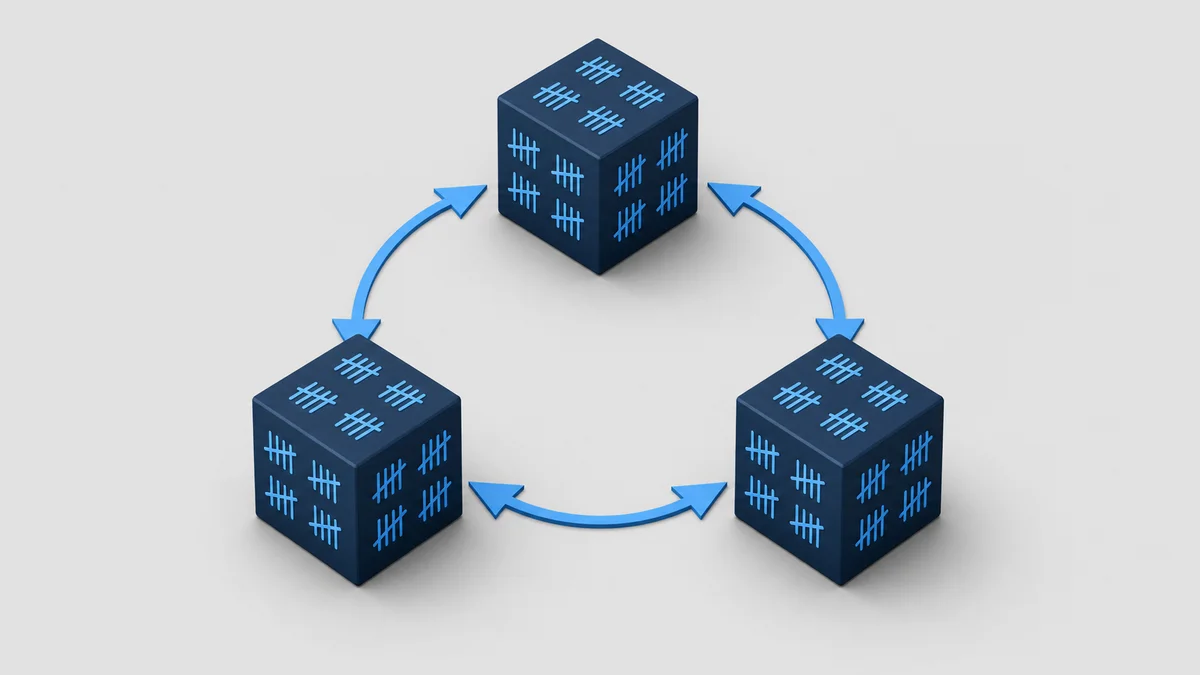
A best AI visibility tracking tool reports citation frequency as a trend line, not a point-in-time result. The minimum requirement is a fixed prompt set run at a consistent cadence across at least two AI platforms, with results stored so a team can compare citation frequency this week against four and eight weeks prior. Tools that run prompts once per reporting period and call that a "share of voice" figure cannot show whether frequency is rising, falling or stable - without a trend, a CMO has no number to present at a board review.
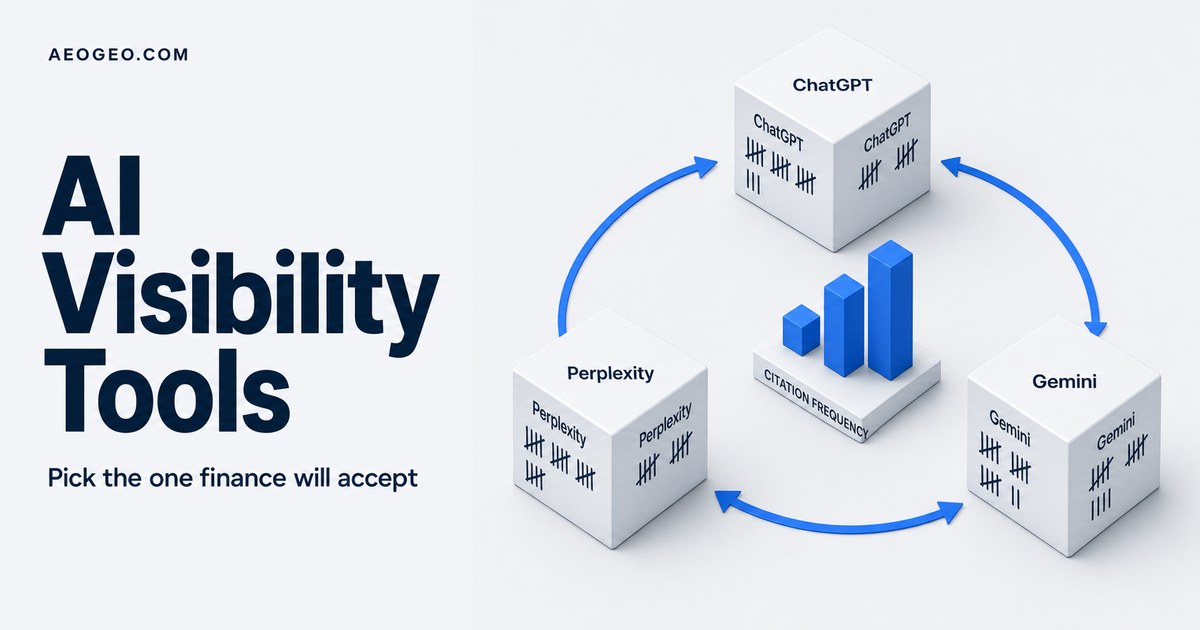
Isometric 3D scene of a repeated prompt sampling loop connecting three AI platform cubes with tally marks
The five non-negotiable attributes of a frequency-tracking tool:
Repeated runs per query (minimum 30 per reporting period, 50 for boardroom confidence).
Fixed prompt set (same queries every period so results are comparable).
Multi-platform storage (results from ChatGPT, Perplexity and Google AI Mode stored separately and in aggregate).
Competitor parity (competitors tracked on the same runs, not separate sessions).
Exportable time series (the trend line must be exportable for a QBR slide or CFO report).
A tool missing any of these five attributes produces data suitable for internal curiosity but not for budget defense.
Which AI visibility tools are built for SaaS and cloud services, not just e-commerce or media sites?
AI search visibility tools built for SaaS and cloud services track the buying-stage queries B2B software buyers actually enter: category comparisons, use-case queries, integration lookups and vendor shortlist prompts. E-commerce-oriented tools focus on product and price queries; media-oriented tools focus on content mentions. A SaaS-focused tool lets a team define prompt sets around the buying committee query map - tracking what founders, CMOs and CTOs each ask AI at different evaluation stages - rather than defaulting to product-category prompts.
The practical test for SaaS fit: ask a vendor how customers define the prompt set. Tools built for e-commerce default to product-category queries. Tools built for complex B2B sales allow prompt sets organized by buyer persona and funnel stage, which matters because 94% of business buyers use AI during the buying process (Forrester, 2026) and a purchase with 13 internal stakeholders generates a much wider query set than a product search.
Which AI brand visibility tool can I put in front of a CFO with a number I'd actually defend?
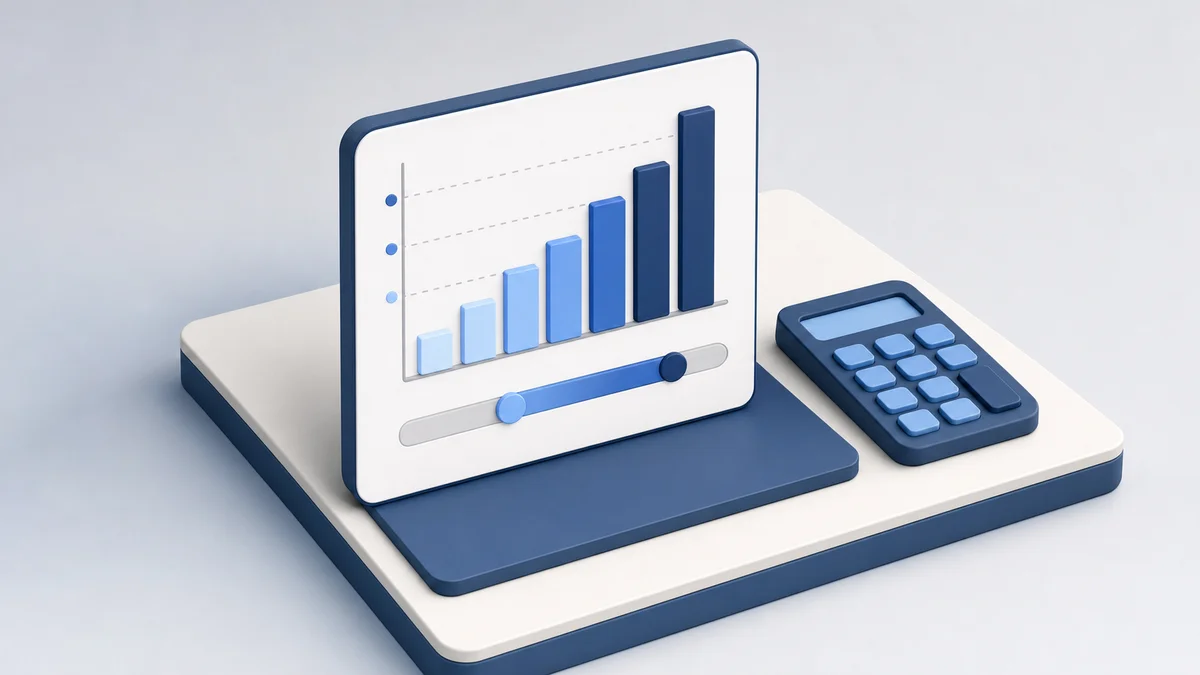
The best AI brand visibility tool for a CFO review reports three things in one export: citation frequency as a range from repeated runs, a competitor comparison on the same prompt set, and a trend line over at least 60 days. The number to present is "our brand was cited in 34 of 50 prompt runs this period, up from 21 of 50 eight weeks ago, while the nearest competitor held at 38 of 50." That is a statistically grounded, time-bound, competitively contextualized claim. A single-run presence score cannot meet this standard.
Isometric CFO desk scene with a citation frequency trend report replacing a traditional ranking chart
Context that strengthens the CFO conversation: AI referral traffic represents 0.1% of total referrals across 35,000 sites (Ahrefs) yet approximately 3% of Ahrefs' own conversions - a gap that explains why citation influence warrants a measurement line even before click volume justifies it.
GrowthSpree audit data (first-party, disclosed): GrowthSpree's paid media audits across 104 Google Ads accounts and $78.0M in total spend found 34.0% of spend wasted on non-converting terms and audiences. Teams recovering that budget have a reallocation argument for AI search measurement programs without adding new spend.
The five-criteria scorecard (illustrative, not financial advice)
Criterion
What to ask the vendor
Pass standard
Sampling methodology
How many runs per query per period?
30+ runs minimum; 50+ for board use
Platform coverage
Which AI platforms are tested?
ChatGPT and Perplexity at minimum; Google AI Mode preferred
B2B SaaS fit
Can prompt sets be defined by buyer persona?
Yes, with persona and funnel-stage tagging
Attribution path
Does the tool link citations to source URLs?
Yes - URL-level attribution required
Entry price
Is there a tier under $1,500/month?
Yes for teams under 50; staged entry preferred
We rank top three on our core queries but aren't cited in AI answers - how do we close that gap?
Ranking in traditional search and appearing in AI-generated answers are distinct outcomes that overlap but do not map directly. The gap between top-three rankings and zero AI citations usually has one of three causes: the AI crawler cannot fetch the page (check robots.txt and CDN bot rules), the page does not answer the query in a directly extractable block (AI engines lift 40-80 word passages, not ranked pages), or the source lacks third-party corroboration. Run the Failure-Point Test on top-ranked pages to identify the cause before investing in more content volume.
The overlap between traditional SEO and answer engine optimization (AEO) - the practice of structuring content so AI engines can extract and cite it - is real but partial. Crawlability and domain authority overlap. Answer format and extraction fit do not: a page optimized for keyword density and internal linking is not automatically structured for AI extraction. Adding a directly extractable answer block at the top of each target page is the fastest path from "rank one, never cited" toward "rank one, cited in 34 of 50 runs."
Position-one CTR dropped 34% when AI Overviews show - what moves the needle on AI search visibility?
When AI Overviews appear on a query, position-one click-through rate falls 34.5% (Ahrefs, April 2025) and 58% in the February 2026 dataset. The response is to appear inside the AI Overview, not to recover the lost click from beneath it. Improving brand visibility in AI search engines means optimizing for the synthesized answer layer: place an extractable 40-80 word answer block at the top of each target page, ensure server-side rendering, and build third-party corroboration.
Three actions move the needle specifically:
Extractable answer blocks: place a 40-80 word direct answer at the top of each target page, before any elaboration, so AI engines lift it without reconstructing meaning from surrounding text.
Server-side rendering on all target pages: client-rendered pages that depend on JavaScript execution are unreliable for AI crawlers, whose rendering behavior differs from Googlebot.
Third-party corroboration: citations from trusted publications pointing to a page raise the probability that AI engines treat it as authoritative. Publishing answer-format content that other sites reference accelerates this. With 70% of digital transformations falling short (BCG, 825 executives), teams that integrate AI readiness into existing content programs rather than treating it as a separate workstream are more likely to sustain the effort.
Which tools show whether our pages are being read and cited by AI search engines?
Tools for analyzing website AI search visibility work at two levels. At the crawl level, server log analysis reveals which AI bots access which pages - OAI-SearchBot, PerplexityBot and ClaudeBot all leave identifiable log signatures. At the citation level, prompt-testing tools record whether a specific page URL is cited on a relevant query. The combination distinguishes two failure modes: the AI can read the page but does not cite it, versus the AI cannot reach the page at all.
A page that receives AI-bot visits but generates zero citations has an answer-fit or trust problem. A page with no AI-bot visits has an access problem - and no content optimization resolves it until crawler access is restored. The log-and-citation combination is the only workflow that cleanly separates the two failure modes.
How do the main AI search visibility tools compare on citation tracking and attribution?
AI search visibility tools comparison across citation tracking and attribution reveals three tiers. Strong tools run 50 or more prompt runs per query, attribute each citation to a source URL, track competitors on the same prompt set, and export a time-series trend. Mid-tier tools run fewer iterations or cover fewer platforms. Weak tools run single-pass checks and report binary presence or absence. Attribution quality is the sharpest differentiator: a tool that logs which URL was cited makes it possible to connect citation data to page-level content decisions.
Tier
Sampling
Platform coverage
URL attribution
Competitor comparison
Trend export
Strong
50+ runs per query
3+ platforms
Yes
Yes, same prompt set
Yes, time-series
Mid
10-30 runs per query
2 platforms
Partial
Yes
Limited
Weak
1 run per query
1-2 platforms
No
No
No
No tool should be evaluated without asking the vendor to state the number of runs per query per reporting period. A vendor unable to answer that question operates in the weak tier regardless of dashboard aesthetics.
Which solutions help a B2B brand appear in AI-generated answers before the shortlist is set?
Brand visibility solutions for AI search that act before the shortlist is set focus on buying-stage queries a buyer types before contacting any vendor. Since 69% of B2B buyers chose a different vendor than planned because of a chatbot recommendation (G2, March 2026), the shortlist often closes before a sales rep is involved. Effective solutions combine prompt-set monitoring across ChatGPT and Perplexity with answer-format content, server-side rendering and third-party corroboration.
The sequence that reaches buyers before the shortlist closes:
Run the Day-One Shortlist Test: submit the 20 queries a buyer types at the start of their evaluation and record whether your brand appears in the first three citations.
Identify which queries return a competitor and not your brand - these are the gap prompts.
Audit the pages most relevant to those gap prompts using the Failure-Point Test.
Fix access, then answer fit, then trust - in that order.
What tools let us manage and monitor AI search visibility across multiple platforms in one place?
AI search visibility management tools that cover multiple platforms let teams submit one prompt set and receive citation results from ChatGPT, Perplexity, Google AI Mode and Gemini in a unified report. Without a multi-platform tool, teams either run separate manual checks on each platform or miss coverage gaps where a competitor is cited on one platform but not another. Platform divergence is significant: a brand cited consistently on Perplexity but absent from ChatGPT is invisible to buyers whose default AI differs - and buyers rarely disclose which platform they used when a sales conversation begins.
Management capability beyond data collection includes:
Prompt set version control: when queries change, historical comparisons must account for the update.
Role-based access: marketing, RevOps and engineering need different views of the same underlying data.
Alert routing: citation frequency drops route to the content team; crawler-access failures route to engineering.
Our position-one clicks dropped sharply when AI Overviews appear - which tool tracks that exposure?
A Google AI Overview visibility tool tracks whether a brand's pages are cited inside Google AI Overviews on target queries. This is distinct from Search Console impression or click data: a page can hold a position-one ranking and still lose 58% of its clicks when an AI Overview appears above it (Ahrefs, February 2026). The tool to look for submits queries to the Google AI Mode or AI Overview layer specifically, records whether the brand is cited, and compares that citation against traditional ranking position for the same query.
Search Console data and AI-citation data together are more valuable than either alone. Search Console shows ranking position and click volume. AI-citation data shows whether the brand appears in the answer that now absorbs the clicks Search Console no longer records.
Which AI search visibility tools go beyond snapshots and show citation trends across repeated prompt runs?
AI search visibility optimization tools that report citation trends across repeated prompt runs store every individual prompt result with a timestamp, so a team can calculate citation frequency for week one, week four and week eight on the same query set. Given the non-deterministic nature of AI answers (SparkToro, 2026), a trend across 50 or more runs per query carries analytical weight that a snapshot cannot. Without stored repeated runs, there is no trend to report.
The practical question to put to any vendor: "Show me a client's citation frequency trend for one query over 90 days, with the number of runs per data point visible." A vendor who cannot produce this - or who produces a trend line built from single runs at monthly intervals - does not operate a trend-capable tool.
Limitations: Who the Five-Criteria Scorecard Is Not For
The five-criteria AI search visibility scorecard on this page helps B2B revenue teams evaluate tracking tools - not rank or endorse specific vendors. Three situations where this guide does not resolve the decision:
Teams with no crawlable website: if AI crawlers cannot access the site - because pages are client-rendered, gated, or blocked by a WAF - no tracking tool produces actionable data. Fix access first.
Teams under 10 people with no measurement infrastructure: the minimum program described here requires someone who can configure GA4 and review data monthly. Below that threshold, the manual program is not sustainable.
Teams looking for guaranteed citation outcomes: no tool and no vendor can guarantee AI citation. Answers are non-deterministic. The output of any tool is frequency data - a probabilistic measure, not a guarantee.
Frequently Asked Questions
What features should an AI visibility tool have?
An AI search visibility tool must run repeated prompt sampling across at least ChatGPT, Perplexity and Google AI Mode, then report a citation frequency range - cited in X of N runs - rather than a single-run result. It should track named competitors on the same prompt set, flag citation frequency drops, map each citation to a source URL, and export data a CMO or CFO can use in a finance review without manual translation.
How do I pick the best AI visibility tool?
Score every tool on five criteria: sampling methodology (repeated runs or one-shot), platform coverage (ChatGPT, Perplexity, Gemini and Google AI Mode at minimum), B2B SaaS fit (can it track the queries your buyers actually type), attribution path (does it link citations to source URLs), and entry price. A tool that scores well on only one criterion produces a number that cannot be defended in a finance review.
How to measure AI search visibility?
Measure AI search visibility with five signals: citation frequency on a fixed prompt set reported as X of N runs; share of answers - the percentage of prompts naming your brand versus competitors; AI-referred sessions tagged in GA4; self-reported attribution from lead forms; and AI-influenced pipeline in the CRM. A single-run prompt check carries no statistical weight, because AI recommendation lists almost never repeat across runs (SparkToro, 2026).
How to monitor AI search visibility?
Run a fixed prompt set of at least 20 queries across ChatGPT, Perplexity and Google AI Mode weekly or fortnightly. Record whether your brand is cited, which source URL is linked, and how competitors score on the same prompts. Add a GA4 custom channel group for chatgpt.com, perplexity.ai and gemini.google.com. Set alerts to trigger when citation frequency drops more than 10 percentage points week over week.
How to identify gaps in AI search visibility SEO?
Apply the three-part Failure-Point Test to each target page: first, confirm the AI crawler can fetch and parse it - check robots.txt, CDN bot rules and server-side rendering; second, confirm the page answers the exact query in an extractable 40-80 word block at the top; third, confirm the source has third-party corroboration. A page that fails any one test will not be cited regardless of its traditional search ranking.
Why choose AI search visibility platforms?
AI search visibility platforms give revenue leaders a trendable number: citation frequency across repeated prompt runs, competitor share of answers, and source attribution. Manual prompt checks produce single-run snapshots with no statistical weight. Because AI recommendation lists almost never repeat across runs (SparkToro, 2026), a manual check showing a competitor cited and your brand absent reveals almost nothing about the actual frequency gap.
Is there a free tool that tracks how often our brand appears across ChatGPT, Perplexity and Gemini?
No fully automated free tool currently tracks citation frequency across all three platforms with repeated sampling and competitor comparison. The minimum-cost alternative is a structured manual workflow: 20 queries run five times each across ChatGPT, Perplexity and Google AI Mode, results logged in a shared spreadsheet, and a GA4 AI-referral channel group to catch inbound sessions. This costs staff time rather than subscription fees and produces monthly frequency data a team can trend.
What concrete advantages do AI search visibility tools give a CMO whose organic CTR is falling sharply?
When position-one click-through rate drops 34.5% because AI Overviews appear (Ahrefs, April 2025), the lost traffic stays inside the AI answer. A visibility tool shows whether your brand is cited there or whether a competitor fills the gap. Citation frequency gives the CMO a second KPI alongside organic sessions: one measures clicks captured, the other measures influence held even when the click never happens.
Conclusion
The exec's screenshot belongs in the Slack channel - but the follow-up question deserves a better answer than another screenshot. An AI search visibility tool earns its budget line when it reports citation frequency from repeated runs on a fixed prompt set, covers ChatGPT and Perplexity at minimum, attributes citations to source URLs, and exports a trend a CFO can read without translation.
Five criteria, applied consistently, separate the tools worth evaluating from those that produce dashboard activity without boardroom weight:
Repeated sampling-30 or more runs per query, 50 or more for finance-facing reports.
Multi-platform coverage including Google AI Mode.
B2B SaaS prompt-set configuration by buyer persona.
URL-level citation attribution.
An entry tier under $1,500/month for teams under 50 people.
A 25-person team not ready for a paid tool should start with a manual prompt set, a GA4 AI-referral channel group and a self-reported attribution field. That baseline is the comparison point that makes any tool's output meaningful four weeks later.
Get the weekly brief on AI search changes, platform updates and citation tracking methods at aeogeo.app.