Blog
AI Crawler Access Audit: How to Check Whether AI Assistants Can Read Your Site
Run an AI crawler access audit in five layers: robots.txt, CDN/WAF rules, rate limits, origin and rendering. Includes a per-bot policy table and owner model.
No single platform proves AI search revenue. See what each measurement layer can and cannot prove, and how to report GEO results to a board as ranges.
 Ishan ManchandaNov 9, 2026

Run an AI crawler access audit in five layers: robots.txt, CDN/WAF rules, rate limits, origin and rendering. Includes a per-bot policy table and owner model.

A vendor-neutral scorecard for choosing who can help you get cited in AI answers: metrics, attribution, kill criteria, contract terms and break-even math.

AI search visibility platforms cost $99 to $20,000 a month. See dated price bands by source and the break-even math: 0.4 to 1.6 deals at $30K ACV.
Request a quote and our experts will contact you within 24 hours with tailored solutions and pricing.
aeogeo.app
Last updated: Nov 9, 2026
By Ishan Manchanda, co-founder of GrowthSpree, a B2B SaaS marketing consultancy founded in 2017. Updated October 28, 2026. Affiliation: aeogeo.com is a GrowthSpree property.
AI search attribution is the practice of tying citations in assistants such as ChatGPT to sessions, leads and pipeline, and in 2026 no single platform does it end to end, so a defensible number layers several methods and reports ranges. For answer engine optimization (AEO) and generative engine optimization (GEO) programs, even the best AI search attribution platforms in 2026 see only part of the picture. In one vendor's 30-day snapshot, 935 of 2,619 recognized AI sessions arrived with a source tag but no referrer (Clickport, 2026). Meanwhile ChatGPT appears in free-text source fields, in direct traffic and in call notes, but not in the dashboard. This guide maps each layer by what it can and cannot prove and explains how to report with stated confidence. Tool selection is covered in AI search visibility tools.
Key Takeaways
- No single AI search attribution platform proves revenue alone; a board-ready number combines GA4 channel grouping, citation sampling, CRM source fields and self-reported attribution.
- GA4's AI Assistant channel misses referrer-less visits and excludes Google AI Overviews and AI Mode (eSEOspace, 2026).
- A 40% citation rate measured over 10 runs carries a 95% interval of 17% to 69% (Arkeon Tech, 2026), so citation frequency should be reported as a range from many runs.
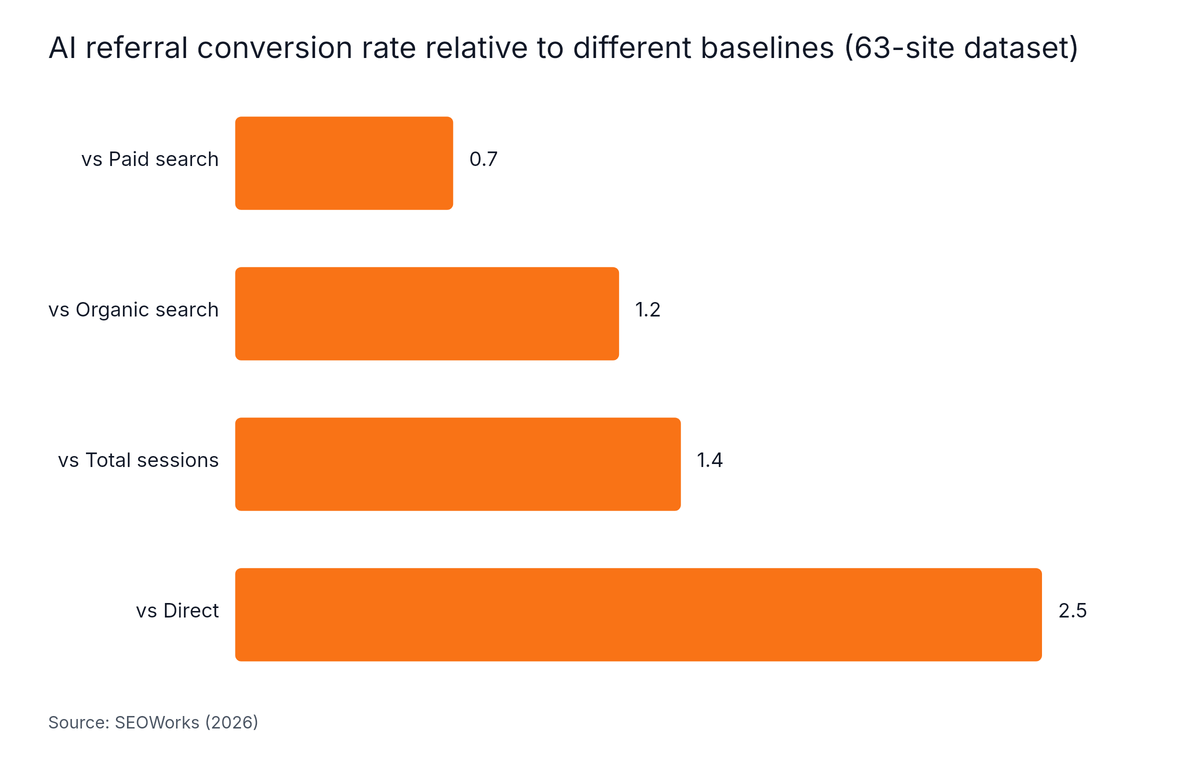
- AI referral conversion claims depend on the baseline: 0.67x versus paid, 1.18x versus organic and 2.48x versus direct in one 63-site dataset (SEOWorks, 2026).
- An agency should report five metrics monthly, each with a method, a sample size and a stated limit.
No single AI search attribution platform produces a board-grade revenue number on its own. Tools fall into capability categories: GA4-native channel grouping, citation-frequency trackers, CRM lead-source reports, self-reported fields and call tagging. Each proves something different. A defensible figure combines several categories and reports a range, because 35.7% of recognized AI sessions in one 2026 snapshot had a source tag but no referrer (Clickport, 2026).

The table uses capability categories, not product names, because a finance team asks what a layer proves, not which brand sells it.
| Capability category | What it measures | What it can prove | What it cannot prove |
|---|---|---|---|
| GA4-native channel grouping | Sessions whose referrer names an AI assistant | Referrer-bearing clicks from named assistants | Visits with no referrer; Google AI Overviews and AI Mode |
| Citation-frequency trackers | How often a brand is cited on a fixed prompt set | Exposure on the sampled prompts | Demand, clicks or revenue |
| CRM lead-source picklists and reports | Last recorded source on a lead or opportunity | Source of leads that reach a form | Buyers who never become a lead record |
| Self-reported attribution fields | What the buyer remembers | Influence, in the buyer's words | Exact share; recall errors |
| Call-recording and win/loss tagging | Mentions of AI tools in conversations | Late-stage influence | Volume across all buyers |
| Session-to-opportunity stitching tools | Tracked visits joined to opportunities | The path of tracked visits | Influence that never produced a tracked visit |
An AI visibility tracker samples citations. An AI search attribution platform joins sessions or leads to revenue. Many products do only the first, and the two jobs are often blurred. Four questions separate them:
Teams comparing tool types can start with the AEO and GEO tools comparison and the guide to AI search visibility tools for B2B SaaS.
A defensible AI search measurement stack has five layers, ordered along the Citation-to-Pipeline Ladder: crawler access, citation frequency, AI-referred sessions, AI-sourced leads by self-report, and AI-influenced pipeline with win rate. Each layer carries a stated method and confidence. Reported buyer use of generative AI ranges from 94% (Forrester) to 45% (Gartner) (Pyxl, 2026), so the stack reports ranges.

The Citation-to-Pipeline Ladder is a five-rung model of crawl, citation, referral, opportunity and revenue, with one metric per rung. AI-influenced pipeline is pipeline in which an AI assistant shaped the buyer's shortlist or decision, whether or not a trackable click occurred. Influence happens inside the answer, and analytics only see the last hop.
The spread between 94% and 45% is itself a lesson. Pyxl reports both figures secondhand and flags the gap as a caveat, noting that survey wording drives the difference. Neither upstream page was retrieved, so verify before quoting either in a board deck.
| Rung | Metric | Method | Main limit |
|---|---|---|---|
| 1. Crawl | Bot access by path | Server logs, robots.txt, CDN rules | Access is necessary, not sufficient |
| 2. Citation | Citation frequency on a fixed prompt set | Repeated runs, interval reported | Exposure only |
| 3. Referral | AI-referred sessions | GA4 channel group plus log capture | No-referrer visits are missed |
| 4. Opportunity | AI-sourced leads | Picklist value plus self-reported field | Recall bias; no-lead buyers invisible |
| 5. Revenue | AI-influenced pipeline and win rate | CRM report, win/loss tags, call trackers | Correlation, not causation |
Each rung answers a different finance question. Rung 1 asks whether the company can be cited at all. Rung 5 asks whether deals changed. Skipping rungs is how a team ends up showing a board a citation count with no revenue link, or a revenue claim with no method.
ChatGPT traffic shows up as direct in GA4 when a visit arrives without a referrer header, because GA4 then has nothing to classify. In a 30-day snapshot saved April 23, 2026, 935 of 2,619 recognized AI sessions, or 35.7%, had a source tag but no referrer (Clickport, 2026). Referrer-only rules therefore miss a meaningful share of AI-driven visits.
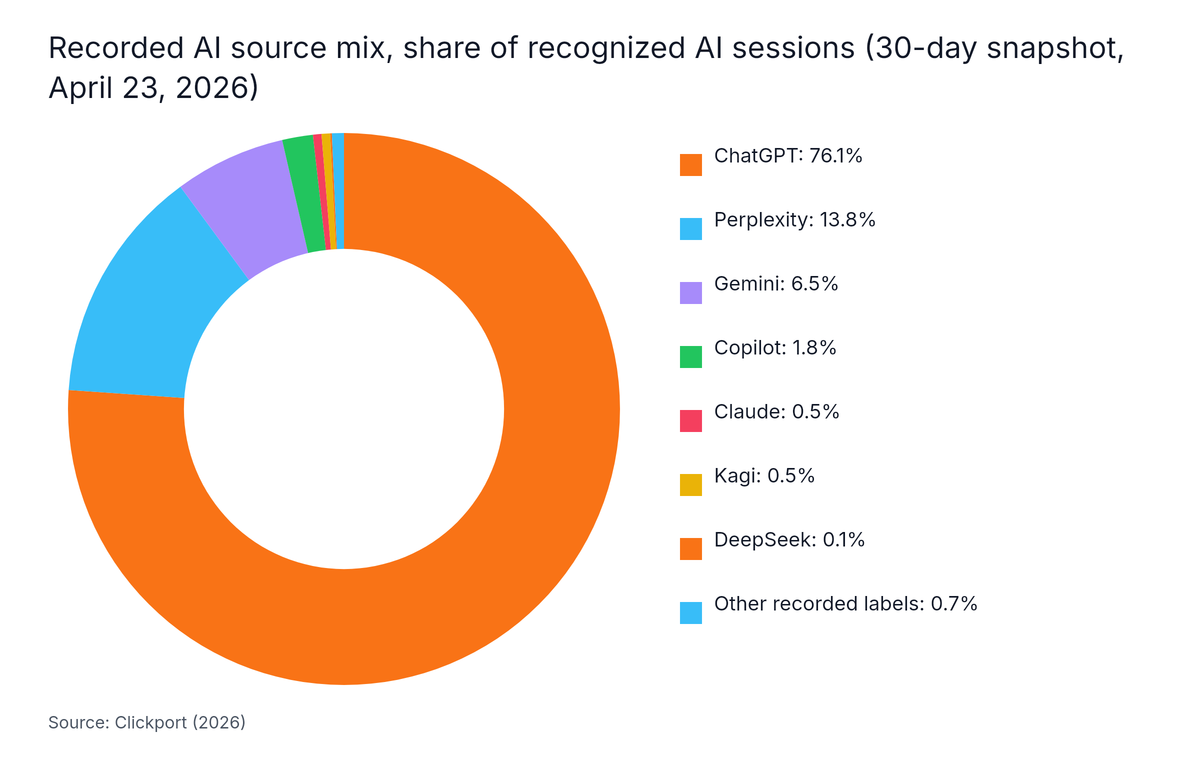
A referrer is the header a browser sends to say which page the visitor came from. When it is absent, GA4 files the session as direct. The same Clickport snapshot found recognized AI search was 0.7% of all recorded sessions (Clickport, 2026), from a small sample of the vendor's own customer sites, so it shows the mechanism rather than a benchmark.
Google added a native AI Assistant channel to GA4's Default Channel Group in May 2026. Google's release notes say: "Google Analytics now provides a dedicated way to measure and analyze traffic originating from popular AI assistants." (Google Analytics Help, 2026) Its boundary matters. The channel definition, as quoted by a secondary source, states: "It excludes Google's AI Overviews and AI Mode." (eSEOspace, quoting Google Analytics Help, 2026) One secondary source also reports the channel is not retroactive. That creates a year-over-year break: traffic reclassified from direct or referral into the new channel will look like growth when it is a relabel.
Source: Clickport, 2026
The Clickport snapshot also shows how concentrated recognized AI traffic is: ChatGPT accounted for 76.1% of recognized AI sessions and Perplexity for 13.8%, with Gemini at 6.5% and Copilot at 1.8% (Clickport, 2026). A setup that tracks only one assistant will undercount the rest.
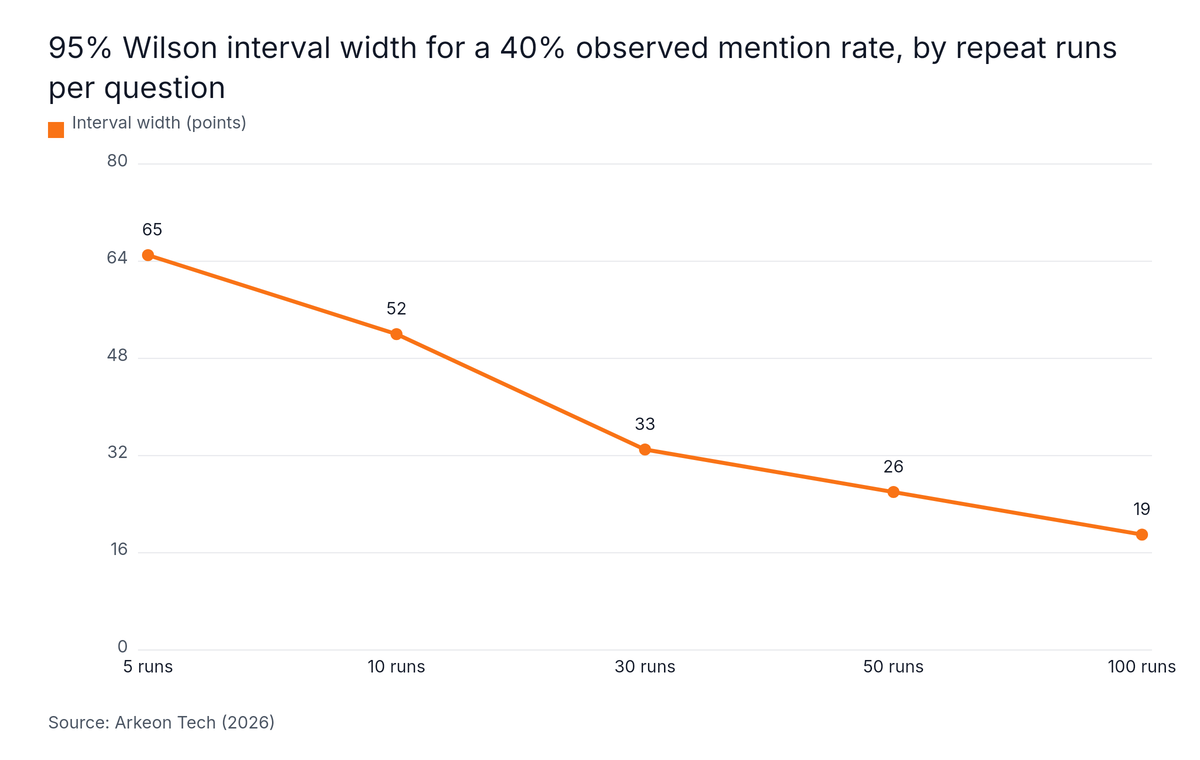
A citation-frequency number needs far more than one check. A 40% observed mention rate from 10 runs has a 95% Wilson interval of 17% to 69%, while 100 runs narrows it to 31% to 50% (Arkeon Tech, 2026). The recommendation here, based on those widths, is 50 to 100 runs per prompt before a figure reaches a board.
Citation frequency is the share of repeated runs of a fixed prompt in which a brand is cited, written as cited in x of N runs. A Wilson interval is a standard confidence interval for a proportion that stays valid at small sample sizes. Arkeon Tech's figures are calculated statistics, so the arithmetic can be checked independently. The 50 to 100 run target is a judgment, not a published standard.
AI answers are not stable between runs. University of St. Gallen researchers measured 4,044 consecutive-day pairs across four AI search engines and four Swiss verticals, from January 24 to March 20, 2026. The rank-biased overlap of cited-source rankings was 0.21 to 0.26, so both the sources and their order change (Schulte, Bleeker and Kaufmann, 2026). It is a preprint and not yet peer-reviewed. A separate arXiv preprint reached a similar conclusion about noise: "Bootstrap confidence intervals reveal that many apparent differences between domains fall within the noise floor of the measurement process." (Sielinski, arXiv, 2026)
| Runs per question | Width of the 95% interval (percentage points) |
|---|---|
| 5 | 65 |
| 10 | 52 |
| 30 | 33 |
| 50 | 26 |
| 100 | 19 |
Source: Arkeon Tech, 2026
The interval width for a 40% observed mention rate falls from 65 points at 5 runs to 19 points at 100 runs (Arkeon Tech, 2026). A reporting line can follow this format: mention rate 40%, 95% interval 31% to 50%, n=100 runs, fixed prompt set of 20. The prompt set, run count and date belong in every such line.
A CRM captures AI-sourced leads when the lead-source picklist includes an 'AI assistant' value and a free-text field keeps the buyer's original words. Self-reported fields still miss buyers who never create a lead record: in one distributor's 2026 data, between 72% and 84% of ChatGPT-assisted customers checked out as guests (Arcalea, 2026).

Self-reported attribution is a lead-source answer the buyer gives in their own words, usually in a how-did-you-hear-about-us field. It captures influence that analytics cannot see, and it carries recall bias. The Arcalea case is a single regional distributor with an ecommerce-style checkout and the vendor's own tracking tool, so it illustrates the limit of lead-form coverage and is not a benchmark.
RevOps teams can map raw answers into a controlled value while keeping the original text in a separate field.
| Raw free-text entry | Normalized picklist value | Note |
|---|---|---|
| ChatGPT | AI assistant | Keep the raw text in a free-text field |
| chat gpt | AI assistant | Match on misspellings and spacing |
| AI, or an AI tool | AI assistant | Flag for follow-up; assistant unknown |
| Perplexity | AI assistant | Optional sub-field for the assistant name |
| Googled it | Search | Not an AI answer unless the buyer says so |
Keep two fields on the lead: the self-reported source and the system-attributed source. Disagreement between them is data, not an error. A lead that says ChatGPT while the system says direct is the pattern a no-referrer visit produces. Tag win/loss notes and call-recorder mentions of AI tools with the same picklist value, so sales commentary reaches the dashboard. The overlap with classic search is mapped in answer engine optimization versus traditional SEO.
AI referral traffic does not reliably convert better than organic search for B2B. In a 63-website agency dataset, AI referrals converted at 0.62 times the organic rate for B2B product businesses, and AI delivered about 3.2 conversions for every 100 from organic search (SEOWorks, 2026). Any conversion claim needs a stated baseline.

The SEOWorks dataset covers 72,095 AI referral sessions against 2,825,594 organic sessions from September 2025 to August 2026. AI referrals produced 5,001 conversions against 155,605 for organic search, and AI traffic converted worse than organic on 23 of 63 sites. The B2B subgroup is small, so treat it as directional.
The same dataset gives different ratios depending on what AI traffic is compared with: 0.67x versus paid, 1.18x versus organic, 1.37x versus total sessions and 2.48x versus direct (SEOWorks, 2026).
Source: SEOWorks, 2026
A vendor post claiming a multiple of organic conversion and a post showing a discount can both be right, because they use different baselines and different sites. The reporting rule is simple: state the baseline, state the sample, then run the same comparison in the company's own CRM on win rate, deal size and cycle length.
Sessions only capture buyers who click. Citation exposure, shortlist influence and recall in sales calls sit upstream of any click. That is why the stack pairs a session layer with self-reported and pipeline layers, and why the AEO ROI calculator guide models payback separately from traffic.
An agency measures generative engine optimization (GEO) performance by reporting five metrics each month on a fixed prompt set: crawler access, citation frequency with a confidence interval, AI-referred sessions, self-reported AI-sourced leads, and AI-influenced pipeline. Each metric states its method and sample size; for example, a 40% mention rate from 10 runs spans 17% to 69% (Arkeon Tech, 2026).

| Metric | Cadence | Method | How confidence is stated |
|---|---|---|---|
| Crawler access | Monthly | Server logs, per-bot policy by path | Pass or fail by path and bot |
| Citation frequency | Monthly, fixed prompt set | Cited in x of N runs | Wilson interval with N shown |
| AI-referred sessions | Weekly | GA4 channel group, log capture | Lower bound plus the no-referrer range |
| AI-sourced leads | Monthly | Picklist value plus self-report | Recall-based, shown beside system source |
| AI-influenced pipeline and win rate | Quarterly | CRM report, win/loss tags, call trackers | Directional; compared with other sources |
Incrementality is the revenue that would not have occurred without the channel, typically tested with holdouts or geographic splits. Attribution assigns credit to touchpoints that occurred. A board should hear both words. Attribution, built from the layers above, says where AI appeared in the journey. Incrementality asks whether pipeline changed because of it, and in AI search that usually needs a staged test, such as a defined set of pages improved while a comparable set is left alone.
Break-even deals equal spend divided by (ACV times gross margin). The figures below are illustrative, assume a six-month engagement and 75% gross margin, and are not financial advice.
| Monthly spend | Six-month spend | Break-even deals at $30,000 ACV | Break-even deals at $100,000 ACV |
|---|---|---|---|
| $1,500 | $9,000 | 0.4 | 0.12 |
| $3,000 | $18,000 | 0.8 | 0.24 |
| $6,000 | $36,000 | 1.6 | 0.48 |
Our data: Salient by GrowthSpree, a managed AEO and GEO service from the parent company of aeogeo.com, reports 48,800 citations, $165,000+ pipeline and $70,000 media-equivalent across its clients (Salient pitch deck; launched September 2026). These are vendor-reported figures from an affiliated service, not independent research.
Agencies that publish a client-facing confidence statement, a stated prompt set and a 90-day kill criterion give a finance team something to audit. For vendor evaluation criteria, see how to choose an AEO or GEO agency and the agency shortlist framework.
The layered AI search measurement approach is not for teams that need one precise revenue figure for AI search, because no such figure exists. It also fits poorly where AI crawlers are blocked or where nobody will run repeated prompts. The method estimates exposure and influence with stated confidence, and it does not prove causation.
Several figures here come from small or vendor-held datasets. The Clickport snapshot and the Arcalea case are single-vendor samples. The SEOWorks B2B subgroup is small. The St. Gallen and Sielinski papers are preprints. None is a universal benchmark, and each should be replaced by the company's own data as soon as it exists.
Trend lines can break for reasons unrelated to performance. GA4's channel change in May 2026 is one. LLM Pulse, a vendor, reports that GA4-synced ChatGPT referral sessions dropped sharply from October 9, 2026, and that only ChatGPT was affected (LLM Pulse, 2026). Searchscore.io, also a vendor, reports that after ChatGPT began showing clickable links in May 2026, homepages rose from 4.4% to 31.2% of its referral traffic (Searchscore.io, 2026). Both are unverified vendor observations, but each is a reason to annotate every quarter-over-quarter comparison. Evidence-backed tactics are reviewed in GEO and AEO techniques with evidence, and team-level tool criteria in AI search visibility tools for marketing teams.
An agency measures GEO performance by tracking five metrics on a fixed prompt set each month: crawler access, citation frequency with a confidence interval, AI-referred sessions, self-reported AI-sourced leads, and AI-influenced pipeline. A credible agency states the method, the number of runs and the limits behind each metric, and reports ranges rather than a single point estimate.
Four capability categories track AI search traffic for B2B: GA4-native channel grouping for referrer-bearing clicks, server-log capture for AI bot visits, CRM reports built on an AI assistant lead-source value, and call-recording trackers for AI mentions. None covers everything, so B2B teams combine them and report the no-referrer share as a range.
GA4's AI Assistant channel does not capture all ChatGPT traffic. It relies on the referrer header, it excludes Google AI Overviews and AI Mode, and one secondary source reports it is not retroactive. Visits without a referrer still land in direct, so a custom channel group and a stated caveat are needed.
A practical recommendation is to run each prompt 50 to 100 times before reporting a citation figure to a board. Arkeon Tech's 2026 calculations show a 95% Wilson interval for a 40% mention rate is 65 points wide at 5 runs, 52 at 10, 26 at 50 and 19 at 100.
Self-reported attribution is useful but incomplete for AI-influenced pipeline. It records what buyers remember, so it shows influence that analytics miss, yet it cannot see buyers who never create a lead record. Report it beside system-attributed source, never as a replacement, and store both values in separate CRM fields.
An AI visibility tracker samples how often a brand is cited in AI answers on a set of prompts, which measures exposure. An AI search attribution platform joins sessions or leads to opportunities and revenue, which measures outcomes. Many tools do only the first, so buyers should ask which of the two a product actually performs.
A board-ready AI search number is a set of ranges with methods attached, not a single figure. Reported buyer AI use alone spans 94% to 45% (Pyxl, 2026), and a 40% citation rate from 10 runs spans 17% to 69% (Arkeon Tech, 2026).
Next step: model payback with the AEO ROI calculator guide, then screen vendors with how to choose an AEO or GEO agency.
Want measurement updates like these each week, with the primary source linked and one action per item? Get the weekly brief
Written by
Ishan Manchanda
Ishan Manchanda is co-founder of GrowthSpree, a B2B SaaS marketing consultancy founded in 2017 that has managed $60M+ in ad spend across 300+ B2B SaaS companies. He focuses on demand generation, go-to-market strategy and pipeline growth, and has been featured in Silicon Valley Times, SaaS Mag and the Unbounce podcast.